From New York Roots to National Reach:
Halmar International Expands Its Footprint in Tunneling, Transportation, and P3 Delivery
Halmar International traces its roots to the incorporation of Halmar Construction in 1962, a firm that grew steadily as a heavy civil contractor delivering transportation and infrastructure projects in New York. Through the 1980s and 1990s, the company continued to expand its geographic footprint, build larger and more complex projects, and strengthen its reputation in the industry.
After a brief merger in the early 2000s, executives Chris Larsen and Paul Atkins founded Halmar International, reestablishing the Halmar name with a stated emphasis on a company culture built on trust and respect. The firm quickly became one of the larger public works contractors in the New York metropolitan area, active in highways, bridges, mass transit, aviation, heavy civil, and underground work.
A major strategic shift came in 2017, when Halmar joined the ASTM Group (part of Italy’s Gavio-controlled infrastructure company), becoming its construction arm in the United States and positioning the company to deliver public‑private partnerships (P3) and additional design‑build transportation projects across North America. Today, Halmar International is headquartered in Nanuet, New York and is recognized as a top‑tier heavy civil construction firm with more than six decades of experience delivering large, complex, and critical infrastructure projects in dense urban environments.
Core infrastructure sectors include:
• Highways and bridges: Design‑build and rehabilitation of major bridges, viaducts, and highway corridors carrying very high traffic volumes.
• Rail and mass transit: Heavy civil works for commuter rail, subways, and station complexes, including structures, track, and associated facilities.
• Underground and tunnels: Transit, water, and energy tunnels, shafts, and underground caverns, often built beneath active cities and transportation systems.
• Aviation: Airside and landside work at major airports, including runway‑adjacent underground utilities and critical airfield infrastructure.
• Civil and environmental: Water and wastewater conveyance, flood and stormwater control, and other civil works in sensitive or constrained sites.
Across these sectors, Halmar embraces alternative delivery models such as Design Build, CMGC, CMAR, and Public-Private-Partnerships (P3s) for large, critical transportation infrastructure projects. As a result of these delivery models, Halmar has become an industry leader in accelerated bridge construction (ABC) which has been incorporated into numerous projects. Some of Halmar International’s notable completed and ongoing projects include large bridge, highway, rail and underground works throughout the country such as:
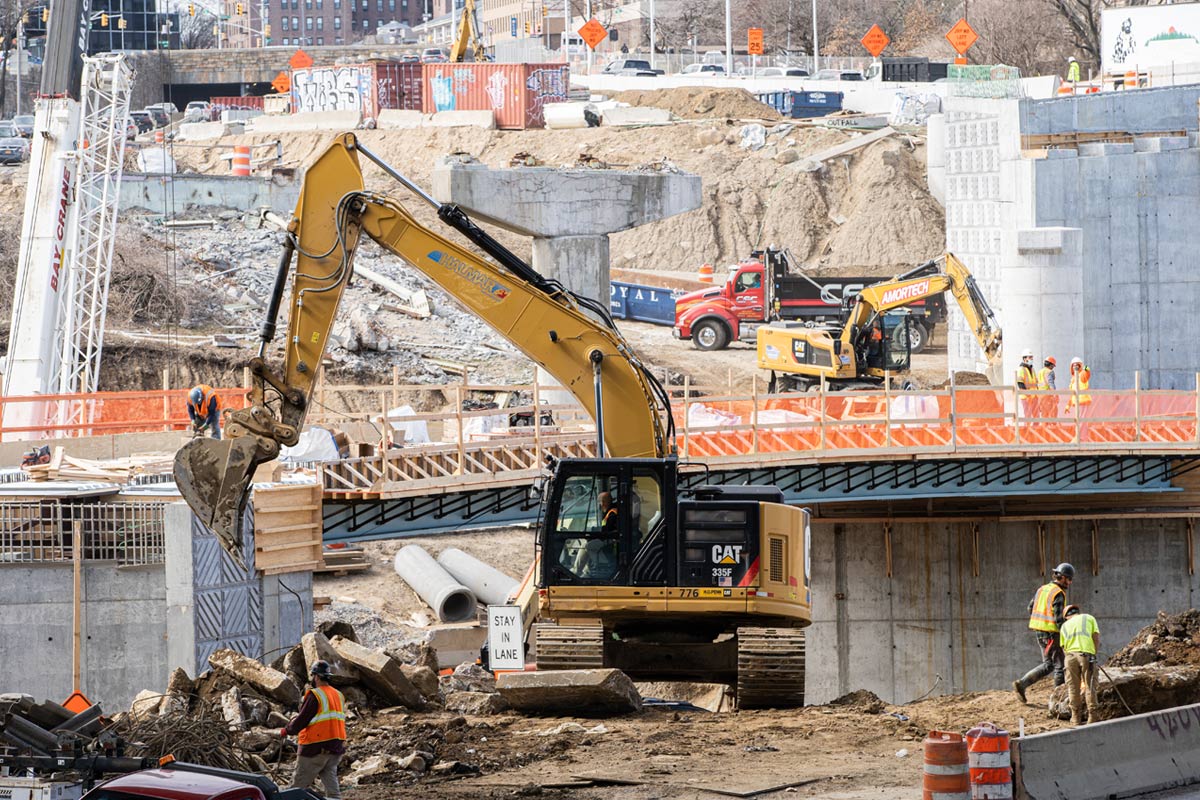
• Park Avenue Viaduct Phase 1: Design Build contractor for replacement of 128 superstructure spans, 8,240 ft of Metro‑North Railroad elevated track over heavily congested New York City streets on the 132‑year‑old viaduct, as of late 2025 the project was 51 months ahead of schedule and $93 million under budget.
• John F. Kennedy International Airport CRUGTC project, part of the $19 billion redevelopment program focusing on rebuilding roadways, utilities and state of the art facilities with modern day features and facilitating airport connectivity.
• The Halmar-built WMATA Potomac Yard Metrorail Station (DC) – received the LEED Gold Certification, the first rail station in North America to receive this certification.
First P3 Project for MTA – ADA Upgrades at 13 Stations – Package 3, operating across 4 of the 5 NYC boroughs.
Largest expansion of MTA-MNR history – Penn Station Access project, building 4 new stations in the Bronx.
New York City rail and ventilation works: Provided rock excavation, drill‑and‑blast, shafts and structural work for projects such as the 50th Street Ventilation Facility and the 7‑Line Extension program in Midtown Manhattan.
• JFK Airport microtunnel: Set an international record with a 1,340‑ft pile drive (53‑in. OD casing, installing 42‑in. ID concrete pipe) beneath active runways at JFK Airport.
• World Trade Center Tower 2 foundations (NYC): Used controlled blasting and specialized rock demolition techniques to construct deep foundations and 130 high‑capacity anchors in a highly sensitive environment adjacent to active transit infrastructure.
Halmar’s continued growth and its 2017 agreement with the ASTM Group coincided with a surge in large tunneling projects in the market, resulting in Halmar bidding on – and winning – contracts in both New York City and Washington, D.C.
“We have never been a contractor that chases easy work,” says Kevin Martin, Deputy CEO. “What sets Halmar apart is that we lean into the most complex, tightly staged projects and figure out how to deliver them in a way that maximizes value, accelerates schedules, and upholds the highest safety and quality standards. Whether it’s a full rail structure replacement over a single weekend or tunneling beneath America’s densest urban environments, we specialize in solving the toughest challenges.”
That mindset continues to define Halmar’s project approach.
With an eye on the future, Halmar has implemented a deliberate leadership development strategy. Deputy CEO Kevin Martin and Deputy COO Sean Burke are taking on broader responsibilities as they help steer the organization forward. The firm has further reinforced its executive team with the recent additions of Leon Jacobs as Executive Vice President and Fabrizio Fara as Vice President of Operations for the Tunnels & Underground Group.
Halmar International Tunneling Projects
As the firm has continued to expand its reach, it has ventured into large-scale tunneling and underground construction projects, most notably the Second Avenue Subway Phase 2 project in New York City and the Potomac River Tunnel in Washington, D.C.
Second Avenue Subway Phase 2
Second Avenue Subway (SAS) Phase 2-Tunneling and Structural Shell Design-Build is being delivered through a contract awarded to Connect Plus Partners, a joint venture led by Halmar International with JV member FCC Construction. The contract is valued at approximately $1.972 billion, is one of the largest tunneling packages awarded in MTA history and is the second of a series of contracts related to the Phase 2 expansion of the Second Avenue Subway.
The SAS Phase 2 program will extend Q Train service from the current terminus at 96th St. north along Second Avenue to 125th St., then west to Park Avenue, roughly 1.5 miles in total. The extension will create three new ADA‑accessible stations at 106th St., 116th St., and 125th St., with the 125th St. station linked directly to the existing Lexington Avenue Line station and to Metro‑North’s Harlem–125th St. Station via a new entrance at Park Avenue. It is expected to serve about 110,000 additional daily riders and significantly relieve crowding on the Lexington Avenue Line while improving access for East Harlem residents.
Connect Plus Partners’ tunneling contract covers construction of new twin bored tunnels between roughly 116th St. and 125th St. using two large TBMs operating 35 to 120 ft below Second Avenue. Crews will excavate the cavern and build the structural shell for the future 125th St. station. The contract also includes reconfiguring an existing 1970s era station between about 116th St. and 120th St. into part of the project, which provides significant cost savings to the MTA.
Early works and design development are under way, with the team advancing means and methods for staging TBM assembly, spoil removal and slurry treatment from very small surface sites. A core challenge is that the main shaft and launch box areas offer limited laydown, narrow frontage and highly sensitive neighbors — including a nearby school — requiring careful planning of deliveries, crane operations and noise and vibration control so that major excavation and tunneling can proceed with minimal community impacts.
Notable technical and logistical innovations include the decision to use variable‑density slurry TBMs that can adapt to mixed ground conditions while limiting settlement risk, and a construction strategy that effectively “threads the needle” by sequencing excavation, underpinning and TBM launch activities inside the existing station. The team is building on Halmar’s previous experience in complex, tightly staged rail and bridge work which includes accelerated weekend replacements of major infrastructure projects, to sequence underground work so that surface disruption is minimized relative to a more conventional open‑cut approach. Preparatory work for mining is currently ongoing in anticipation of TBM arrival in early 2027.
Potomac River Tunnel
The Potomac River Tunnel project in Washington, D.C., is the final and one of the most complex elements of DC Water’s Clean Rivers Program, designed to dramatically reduce combined sewer overflows to the Potomac and improve water quality for the nation’s capital. On the Halmar side, the project is being led by Filipo Boccalini, Deputy Project Manager; Norman Fell, Senior Construction Manager; and Joe Craig, General Superintendent.
The $819 million project centers on a 5.5‑mile, 18‑ft diameter deep tunnel running under some of the most sensitive areas and monuments in the country. Driven from West Potomac Park with two TBMs—one mining north toward Georgetown and one south toward Joint Base Anacostia‑Bolling (JBAB), where it will connect to the existing Anacostia River Tunnel and ultimately to the Blue Plains treatment plant. Along the alignment, the CBNA‑Halmar JV is constructing nine shafts and a series of complex near‑surface CSO structures and adits that intercept existing sewers and drop flows safely into the tunnel system. The two TBMs are configured differently — a hybrid slurry/open machine in the north and a dual‑mode slurry/EPB machine in the south — to handle changing geology from hard rock to alluvial sands and clays.
As of early 2026, the north TBM has been assembled in the starter tunnel at West Potomac Park with launch anticipated in the middle of March. The JV is completing the base slab in the downstream TMS shaft, which will be temporarily backfilled with flowable fill so the north TBM can bore through before the south machine — scheduled to be delivered in summer 2026 — is assembled and begins its drive. Full two‑direction mining is expected to ramp up in 2027 ahead of substantial completion around 2029–2030.
One of the defining technical features is the use of two different TBM types on a single alignment, each supported by dedicated surface slurry and processing systems that must be fitted into extremely tight sites in and around national landmarks. To support the tunnel drives, the JV and its subcontractor have also designed and built a new precast segment manufacturing plant from scratch in Maryland, providing quality control and logistical certainty for thousands of lining segments. The project team is managing a highly congested and sensitive work environment: blasting shafts and tunnels near the Lincoln Memorial, constructing deep CSO structures within about 30 ft of the Potomac River, and working directly adjacent to the Watergate complex and on Georgetown University property, all while meeting stringent National Park Service and federal security requirements. A dedicated muck‑handling operation — using conveyors to a centralized load‑out at West Potomac Park and specialized disposal routes for contaminated material at CSO 22 — keeps tunnel operations moving despite the urban constraints.
Looking Ahead
Halmar anticipates increased opportunities for underground work across the country, driven by aging water and sewer systems, resilience needs, and large transit investments. In addition to its core market in the New York area, these new opportunities will continue to build upon established work in the Mid-Atlantic and West Coast while entering new markets in the southeast such as Atlanta and Nashville.
“Halmar has traditionally been focused in the Northeast, however with the support of the ASTM Group increased opportunities in the underground, transportation and P3 markets nationwide have led us to branch out to the mid-Atlantic, as well as the West Coast,” said Leon Jacobs, Executive Vice President. “We see that trend continuing with high demand nationwide.”
Additionally, Halmar is well positioned in the underground rehabilitation market through its affiliate Ashlar Structural, which specializes in structural shotcrete and trenchless pipe lining. With storm, sanitary and water pipelines deteriorating nationwide, the team sees a growing market of shotcrete and geopolymer lining projects for sewers, culverts and other buried structures, creating a consistent volume of smaller‑scale opportunities that complement headline megaprojects.
Ultimately, Halmar leadership continues to see the company excelling in the area of alternative delivery projects, including design-build and P3, which favors firms with strong preconstruction, in‑house engineering and a track record of devising innovative construction approaches and schedules. Halmar’s access to capital and integrated concession expertise through its affiliation to the ASTM Group provides a seamless role for Halmar to function as a builder on P3 projects. With funding an issue for municipalities and agencies across the country, P3 projects provide a viable option to advance work.
“Unlike a traditional P3 where the contractor and equity provider may have diverging priorities, ASTM and Halmar come to the table with aligned goals on cost, schedule and long‑term asset performance,” Jacobs says. “That gives us an advantage and opens opportunities to pursue a wide range of projects across the country.”

Comments are closed here.