
Final Breakthroughs Achieved in Brenner Base Pass Main Tunnels
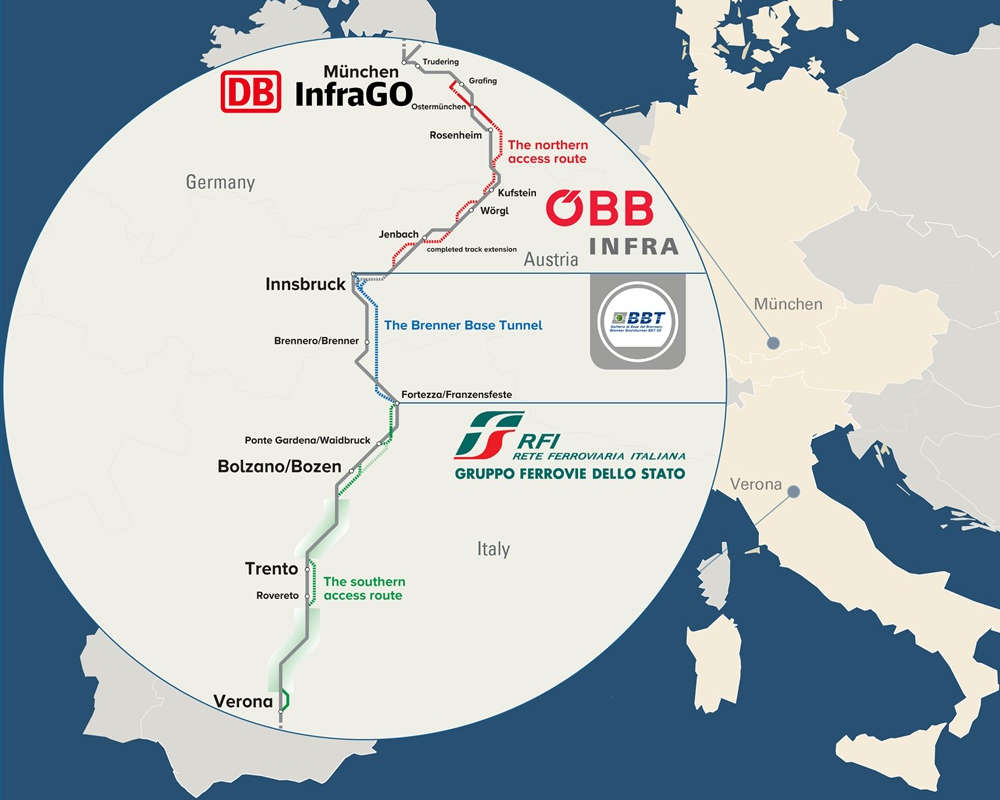
At approximately 1,400 m beneath the Brenner Pass in the Alps, the final barriers of rock separating Austria and Italy have been broken through, creating two cross-border connections within the eastern and western main railway tunnels, Webuild announced on July 28. The breakthroughs have established a continuous underground corridor between the two countries. At a total length of 64 km including the Innsbruck bypass, the Brenner Base Tunnel is the world’s longest underground railway. The Italian section of the project is being delivered by a consortium led by Webuild on behalf of BBT SE. The project represents the core of the Scandinavian-Mediterranean Corridor of the Trans-European Transport Network (TEN-T), linking Helsinki to Valletta and incorporating the Munich-Verona axis.
The milestone marks the joining of excavation works on Austria’s H53 Pfons-Brenner lot and the already completed main tunnels of Italy’s H61 Mules 2-3 lot, built by the Webuild-led consortium. Following the breakthrough achieved in the exploratory tunnel last September, the border between the two countries has now been breached inside the main line tunnels as well. Two excavation methods were used: on the Italian side, the main tunnels were excavated by tunnel-boring machines (TBMs) Virginia and Flavia, while on the Austrian side it was done using the conventional drill-and-blast method.
Webuild is playing a leading role in the construction of the Brenner Base Tunnel, with more than 50 km of tunnels bored across four lots, two of which have already been completed: the Isarco Underpass Lot in Italy at the southernmost section of the tunnel before the Fortezza station, and the H33 Tulfes-Pfons Lot in Austria. The Group’s involvement along the Munich–Verona axis also extends to two additional projects for RFI (FS Italiane Group): the upgrading of the Fortezza–Ponte Gardena railway section and the Trento Bypass. These projects further enhance the efficiency and capacity of the railway system connected to the Brenner Base Tunnel, strengthening its role as a key infrastructure asset for the competitiveness of both Italy and Europe.
Once completed, the Brenner Base Tunnel will allow passenger trains to travel at speeds of up to 250 km per hour, reducing travel times between Fortezza and Innsbruck from 80 minutes to just 25 minutes. Designed to shift both freight and passenger traffic from road to rail, the infrastructure will contribute to the decarbonization of transport across the Alpine region, reducing air and noise pollution. With nearly 3,500 km of tunnels completed worldwide, Webuild confirms its position among the global leaders in the delivery of complex infrastructure projects supporting a more connected and sustainable European mobility network.
The milestone reached at the Brenner reflects Webuild’s commitment to the development of major infrastructure projects across Northern Italy, where the Group is involved in 10 strategic projects, employing more than 8,800 people, directly and indirectly, and engaging a supply chain of approximately 4,900 companies since the start of works.
Alongside the Brenner Base Tunnel, Webuild is undertaking highly complex projects in the North of Italy, such as the Genoa Junction and Terzo Valico dei Giovi Project and the New Genoa Breakwater, both aimed at strengthening the Ligurian port and its connections to the European rail network. It is also involved in the Verona-Padua High-Speed/High-Capacity railway, the Lombardy Pedemontana Motorway and the Pedemontana Piemontese road project.


Comments are closed here.