Microtunneling Drives Recognized Among Trenchless Technology Projects of the Year
Trenchless Technology, the leading voice of the trenchless marketplace, has revealed the winners of its 33rd annual Projects of the Year for 2026 — the industry’s most prestigious project honors. The magazine presents awards in two categories: New Installation and Rehabilitation.
Trenchless Technology made the announcement Sept. 24, during a special Trenchless Perspectives Live webinar held in celebration of World Trenchless Day.
This year’s top projects highlight innovative uses of microtunneling, and cured-in-place pipe (CIPP) and other trenchless methods.
“Each year, the Projects of the Year remind us just how much skill, ingenuity and teamwork go into tackling some of the industry’s most demanding projects,” says Trenchless Technology Editor Sharon M. Bueno. “This year’s winners demonstrate the many ways trenchless technologies are being used to solve complex construction challenges and get the job done. It’s exciting to see the innovation happening across our industry, and we’re proud to recognize the contractors, engineers, owners and project teams behind these outstanding accomplishments. Congratulations to all of our 2026 winners!”
New Installation Projects of the Year
The 2026 Project of the Year for New Installation is the Tri-City Water Resource Recovery Facility (WRRF) in Oregon City, Oregon, one of the longest, largest, most geometrically complex microtunnel installation projects in North America.
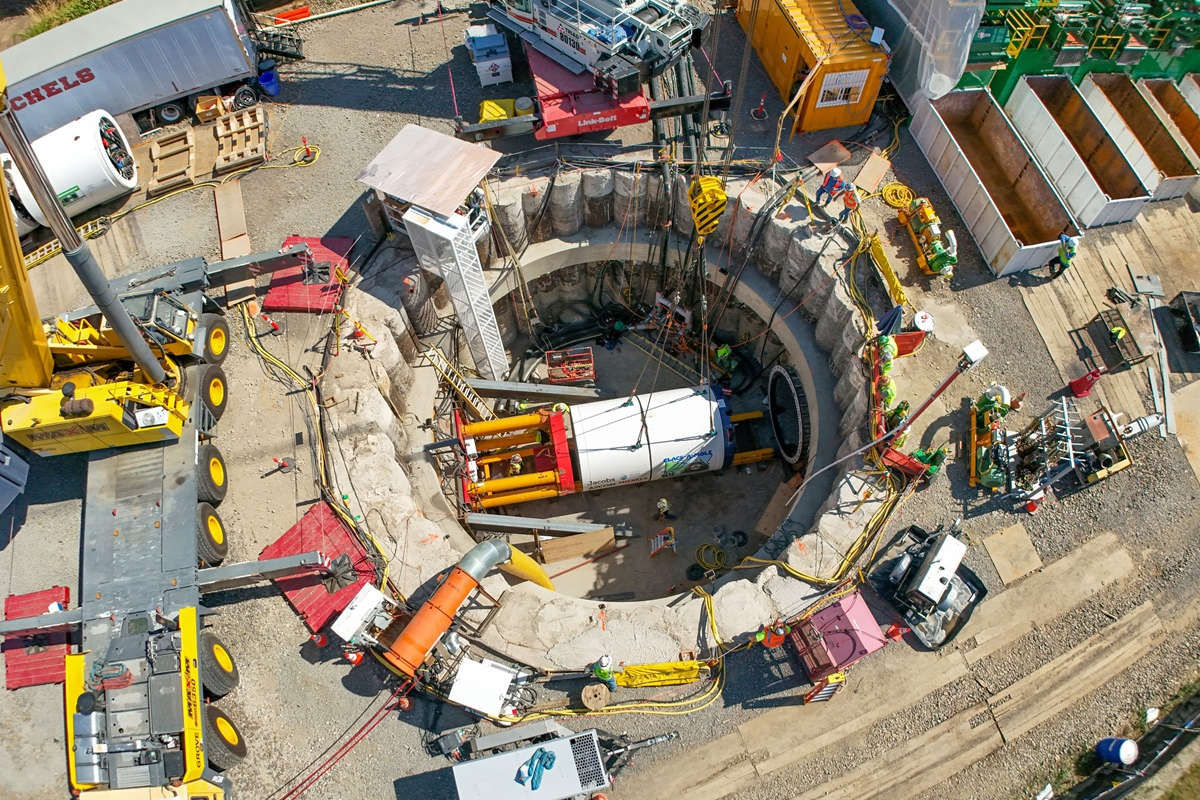
The scope included the installation of approximately 5,000 ft of 90-in. ID effluent pipeline from the Tri-City WRRF to the Willamette River in Oregon City. Crews installed approximately 2,400 ft of 90-in. fiberglass pipe (FRP) through an unpermitted landfill via open-cut, approximately 2,400 ft of 90-in. hybrid reinforced concrete pipe/FRP jacking pipe via continuous microtunneling and wet retrieval, 200 ft of submarine diffuser within the Willamette River, and a 40-ft diameter secant shaft for the microtunneling entry point.
Working with partner AECOM, Michels also completed cured-in-place pipe rehabilitation of an existing sanitary sewer and the construction of two maintenance structures.
The project site was shared with a bridge-widening project, which required the design and execution of the Tri-City WRRF Outfall project to take place adjacent to and underneath the ongoing construction — 70% of which was conducted above the water table. The project’s custom-built microtunnel boring machine, nicknamed “Clack-A-Mole” through a public voting process in Clackamas County, was equipped with an upsized motor for increased torque, specialized slurry controls, and an airlock for contingency purposes when carrying out the installation below the water table.
The Tri-City WRRF Outfall Project required advanced trenchless solutions to deliver this critical piece of public infrastructure. While the project’s size, length, and overall complexity are impressive, the collaboration and innovation across all parties helped deliver a successful solution.
Earning honorable mention accolades were the Pleasure Bay Interceptor for the Two Rivers Water Reclamation Authority in Monmouth Beach, New Jersey, and the Giga Factory Texas Offsite Wastewater Interceptor for Tesla in Texas.
The Pleasure Bay project involved a new 50-mgd pumping station, deep shafts and a 3,300-lf, 54-in. interceptor sewer installed within a 9-ft diameter tunnel beneath the Shrewsbury River in New Jersey. Unexpected flowing sand encountered 2,100 feet into the drive engulfed the earth pressure balance tunnel boring machine (EPBM), forcing an emergency evacuation, loss of the machine and complete interceptor redesign.
KUE, Northeast Remsco and engineer Hazen developed an innovative recovery strategy requiring a slurry microtunnel boring machine (MTBM) to enter the failed rib-and-board tunnel more than 100 feet beneath the river. The team designed a specialized chamber using composite ribs and boards, bulkheads and low-strength grout to accommodate the MTBM. A retractable machine and curved alignment using 10-ft steel casings with radial bending joints enabled crews to reach the tunnel while avoiding unstable ground near the failed TBM.
Completed in early June 2026, the project achieved three milestones: the first planned tunnel entry into an existing rib-and-board tunnel, the first U.S. use of a retractable MTBM and the first planned curved microtunnel using steel casing.
Completed in January 2026, the Giga Factory Texas (GFTX) Offsite Wastewater Interceptor Project expanded wastewater capacity for Tesla’s rapidly growing Gigafactory, replacing an undersized pump station and forcemain with a gravity system connected to Austin’s existing Govalle Tunnel. Ward and Burke Tunneling Inc. installed approximately 4,251 lf of microtunnel beneath State Highway 130, a Kinder Morgan gas main and the Colorado River, using Herrenknecht AVN 1200 and AVN 1800 machines in challenging mixed ground and groundwater conditions.
The project faced significant obstacles, including locating a deeply buried, surcharged existing tunnel, encountering an abandoned shaft during caisson construction and completing an underwater connection to a live sewer serving a 75-mgd wastewater treatment plant. Hazmat divers performed the tie-in after months of coordination among project partners. A main bearing seal fault midway through the longest drive required an expedited machine replacement, completed in two shifts.
Despite the tight schedule and technical challenges, the team successfully completed and commissioned the project. Its 3,609-ft, 72-in. tunnel is among the longest microtunnel drives in the United States.
The NorthRiver Midstream NEBC Connector in British Columbia and Alberta Canada for NorthRiver Midstream was the Runner-up selection. It was recognized for its innovative HDD installation.
Rehabilitation Projects of the Year
This year’s Project of the Year for Rehabilitation is Northwest Interceptor Rehabilitation Project in Winnipeg, Manitoba, Canada.
The Northwest Interceptor is a critical 60-in., non-reinforced concrete sewer crossing under a railway at a 45-ft depth into the North End Water Pollution Control Center installed in the late 1970s. This $2.8 million, 1,300-ft, fast-tracked project utilized CIPP to properly rehabilitate the interceptor under -40 F winter temperatures.
The design-bid-build project also implemented recommendations from Phase 4 of NASSCO’s study on the impact of styrene and high-temperatures have on biochemical oxygen demand-driven wastewater treatment processes. Completion of this project resulted in more than $11 million in overall project savings.
Other projects recognized in the Rehabilitation category are: MWRD Northshore Sliplining Project, greater Chicago area (runner up); Port Authority Logistics Park Infrastructure Improvements, Alabama (Honorable Mention); HOVMSD Fox River Interceptor Rehabilitation, Kaukauna, Wisconsin (Honorable Mention).
RELATED: 2025 Tunnel Achievement Award – RiverRenew Project