
Engineering a Cleaner Future Beneath Alexandria
RiverRenew Project Earns Tunnel Achievement Award
Alexandria, Virginia, is a historic and vibrant city nestled just across the Potomac River from Washington, D.C. With roots that date back to the early colonial period, Alexandria emerged as an important shipping and commercial hub. Today, it has evolved into an upscale community of more than 150,000 residents, its Old Town district bustling with shops, restaurants, and riverside activity.
Yet, Alexandria’s rich history brings with it unique challenges for those entrusted with maintaining and upgrading its infrastructure. Like many older American cities, Alexandria’s sewer system—managed by the local authority, AlexRenew—must be modernized to meet present and future needs. In 2017, a Virginia law mandated the remediation of combined sewer outfalls, setting the stage for the ambitious RiverRenew program. Forced onto a tight timeline, AlexRenew has made remarkable progress on what is the largest infrastructure undertaking in the city’s history.
At the heart of RiverRenew is the 2-mile-long, 12-foot-diameter Waterfront Tunnel. This tunnel is designed to capture overflow from four outfalls, channeling it to the AlexRenew treatment plant and delivering significant water quality improvements to local waterways, including Hooffs Run, Hunting Creek, and the Potomac River itself. Once complete, the system is expected to prevent the discharge of 130 million gallons of untreated wastewater every year.
The Waterfront Tunnel completed its drive in March 2024, and the entire RiverRenew project is on track for completion by the revised deadline of July 1, 2026. In recognition of the project team’s innovative planning and design, the successful navigation of complex urban and geological challenges, and the far-reaching clean water benefits that will result, RiverRenew has been named the Tunnel Achievement Award winner for 2025.
The Tunnel Achievement Award, established in 2012, celebrates completed projects that exemplify innovation, teamwork, and positive community impact. The honor is presented in partnership between TBM: Tunnel Business Magazine and the Breakthroughs in Tunneling Short Course, held annually at the University of Denver in Colorado.
Project Background
When Virginia lawmakers passed the 2017 requirement for combined sewer outfall remediation, they set an initial deadline of July 1, 2025. Planners were left with just eight years to design, procure, and construct a technologically advanced solution—beginning with little more than a line on a map. “We were put on a crash course, from nothing but a drawing to a completed, operational system in just eight years,” recalls Justin Carl, AlexRenew’s CEO.
To more effectively manage the undertaking, AlexRenew assumed responsibility for the City of Alexandria’s outfall facilities in 2018, becoming the lead agency for the RiverRenew initiative. With no prior tunneling projects under their belt, AlexRenew adopted a fixed-price, design-build approach. This contracting method enabled the team to keep the compressed construction schedule on track while pushing forward on geotechnical studies, design development, easement negotiations, third-party agreements, and community outreach—all before even awarding the final contract. Project elements were packaged under a single contract to streamline delivery.
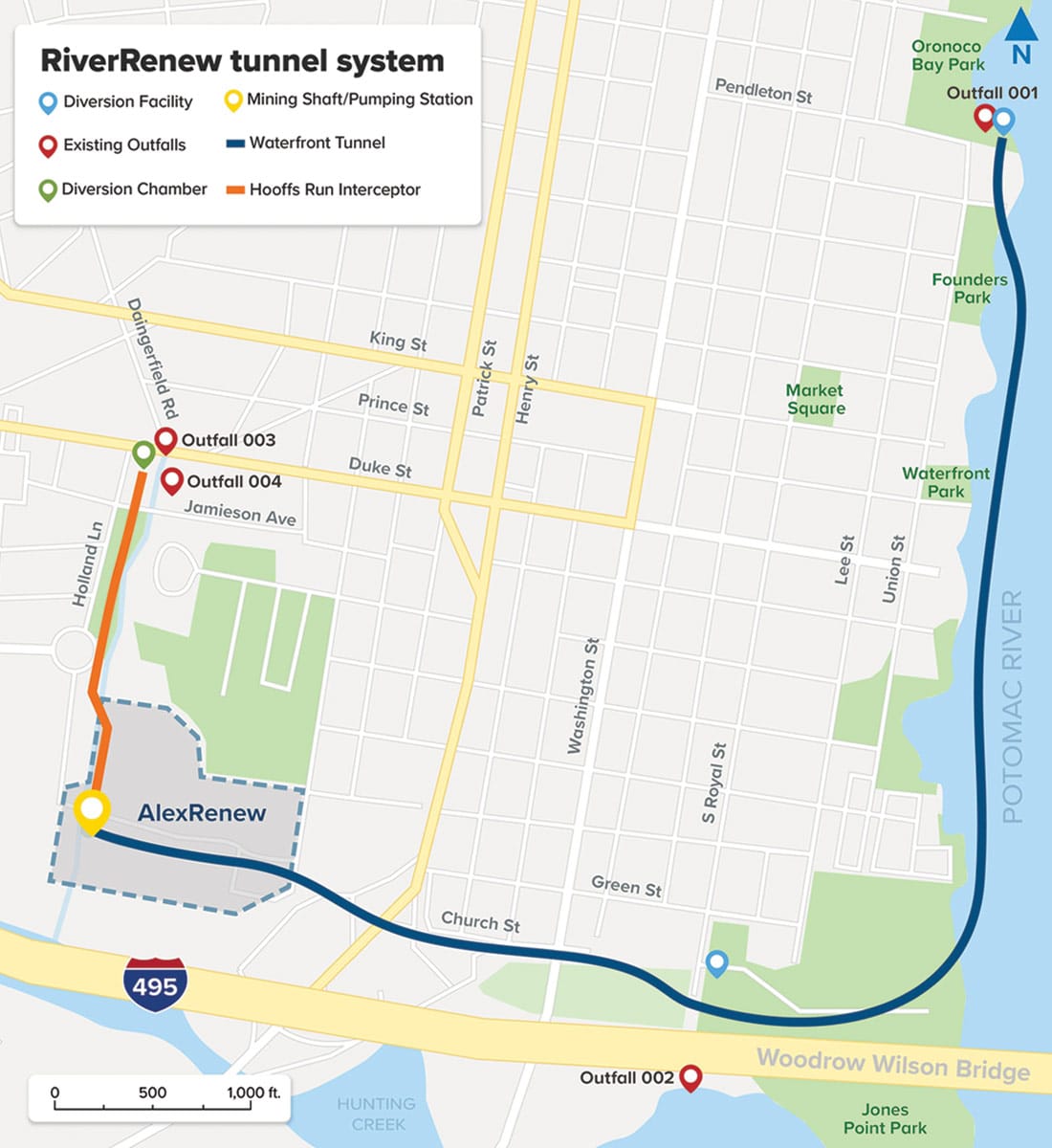
The RiverRenew project consists of:
- Four new diversion structures on existing outfalls surrounding Old Town Alexandria
- Four shafts ranging from 35 to 65 feet in diameter, reaching up to 130 feet in depth
- A 12-foot-diameter Waterfront Tunnel, over 11,377 feet long, located 115 to 160 feet below ground
- 2,500 linear feet of new 72-inch interceptor pipeline (the Hooffs Run Interceptor)
- A new Tunnel Dewatering and Wet Weather Pumping Station with capacities of 20 million gallons per day (mgd) for tunnel dewatering and 180 mgd for wet weather events
- A relocated outfall and various related near-surface structures
In November 2020, two years after starting the project, AlexRenew awarded a contract to the Traylor-Shea Joint Venture, comprising Traylor Bros., Inc., and J.F. Shea Co., supported by Jacobs Engineering and Corman Kokosing Construction Co. EPC Consultants oversaw resident engineering and inspections, while Brown and Caldwell and Schnabel Engineering provided program advisory, including conceptual design and alignment studies.
Construction
Traylor-Shea received Notice to Proceed on December 1, 2020. The Herrenknecht EPB Tunnel Boring Machine (TBM) completed its factory acceptance tests in April 2022 and arrived onsite that July. After assembly began in August, boring commenced on November 1. Sixteen months later, in March 2024, the TBM broke through at the Pendleton Street shaft, marking the end of its subterranean journey.
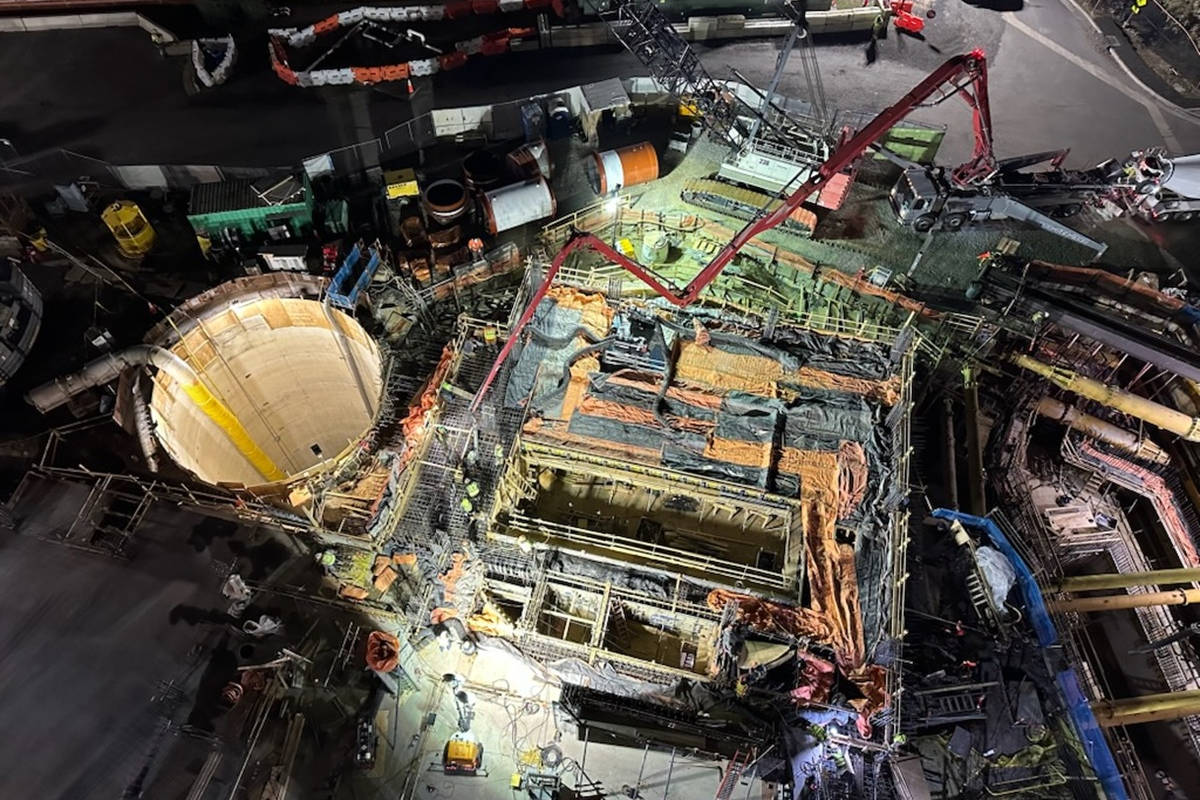
The breakthrough took place in a 100-foot-deep shaft immediately south of Oronoco Bay. This shaft will collect combined sewage overflows and direct them to AlexRenew via the new tunnel, creating a vital connection between the city’s four historic outfalls—dating back to the 1860s—and the modern wastewater treatment plant.
Excavation required more than 15,000 concrete tunnel segments and the removal of nearly 78,000 cubic yards of soil. The Waterfront Tunnel alignment travels beneath the Potomac River, passing through both the Potomac geologic formation and alluvial material.
Another key component of RiverRenew is the 2,300-foot Hooffs Run Interceptor, which began accepting flows in December 2024. This crucial infrastructure is expected to reduce overflow events from Outfall 4 from 45 annually to fewer than four. Portions of the interceptor were excavated using a Herrenknecht 76-inch Microtunnel Boring Machine (MTBM).
With two diversion facilities nearing completion, the main remaining task is finishing the pumping station superstructure at the wastewater treatment plant. The dual-level pumping station houses a 180-million-gallon wet weather pumping capacity on its upper level, and a 20-million-gallon tunnel dewatering station on the lower level, all within a 72-foot diameter, 12-story-deep shaft.
Community Connection and Technical Ingenuity
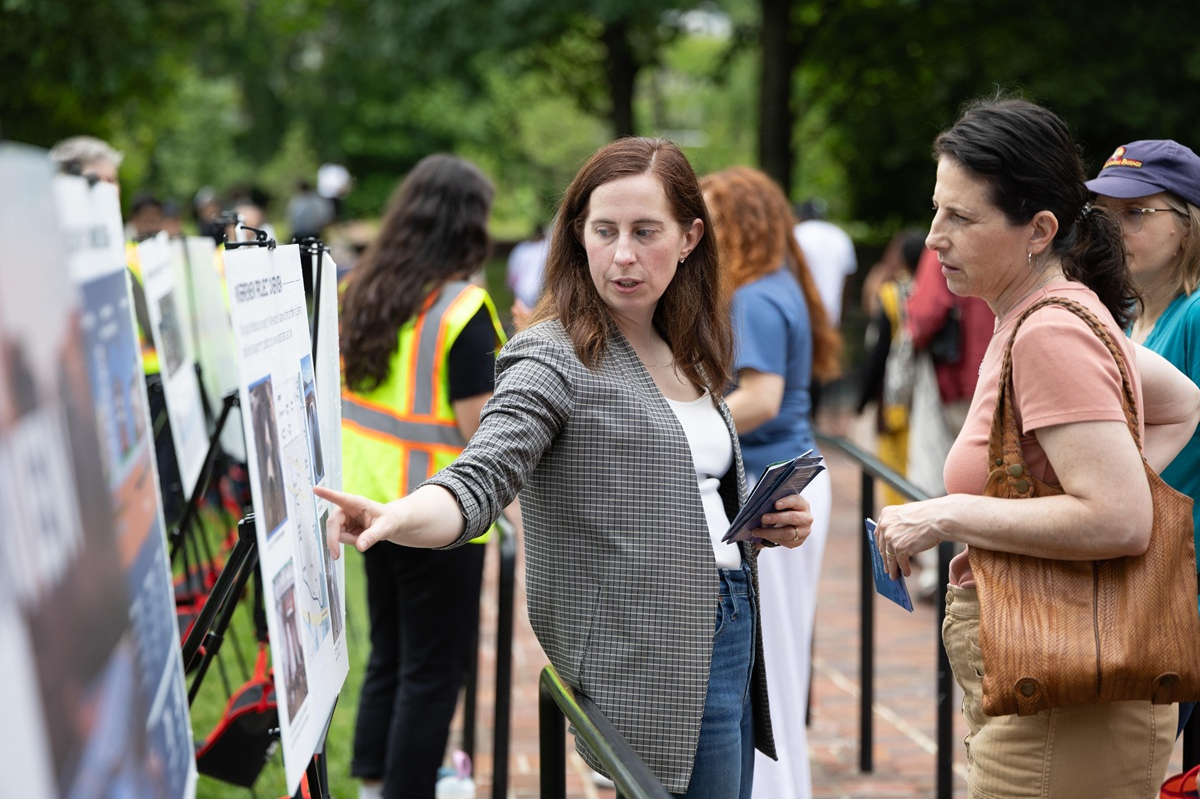
Amid the technical challenges, AlexRenew has made community engagement a cornerstone of the project. “Community outreach was a heavy component, especially in the early years of planning, permitting, and negotiating easements,” says Caitlin Feehan, Chief Administrative Officer. “With more than 60 civic associations, as well as critical agreements to be negotiated with the Virginia Department of Transportation, the National Park Service, private developers, and others, securing local buy-in was vital—particularly given the tight schedule.”
Engagement has continued throughout construction, with public celebrations and informational meetings marking key milestones. “We had 1,500 people come out to cheer on the TBM as it completed its journey,” says Matt Robertson, AlexRenew Director of Communications. “To have that kind of support for an infrastructure project is amazing.”
The project also featured technical innovation. “We decided to include a functional baseline in the Geotechnical Baseline Report,” explains Jennifer Jordan of Schnabel Engineering. “We had a lot of data on the Potomac Formation, which is excellent for tunneling. But as we neared the Potomac River and encountered Alluvial materials, instead of providing geotechnical baselines for the ground, we established functional baselines for the TBM advance rate—which are easier to measure and proved more reliable.”
A Clean Future for Alexandria
With the Hooffs Run Interceptor now accepting flows, RiverRenew is already making its mark. Upon final project completion next year, AlexRenew anticipates a 98 percent reduction in sewer overflows. “We’re building this system for a brighter future for Alexandria and the region,” says Carl. “We’re helping to achieve the vision of a fishable, swimmable Potomac River in the future.”
Tunnel Achievement Award Winners
Established in 2012, the Tunnel Achievement Award recognizes successfully completed projects that demonstrate innovation and teamwork and provide benefits to the community. The award is presented by the organizers of the Breakthroughs in Tunneling Short Course in conjunction with TBM: Tunnel Business Magazine.
- 2025: RiverRenew Project, Alexandria, VA
- 2024: Jefferson Barracks Tunnel, St. Louis, MO
- 2023: Mill Creek Drainage Relief Tunnel, Dallas, TX
- 2022: Kemano T2 Tunnel, Kitimat, BC
- 2021: DigIndy Tunnel System, Indianapolis, IN
- 2021: Gary Brierley, Dr. Mole Inc. (Lifetime Award)
- 2020: Regional Connector, Los Angeles, CA
- 2019: Ohio Canal Interceptor Tunnel, Akron, OH
- 2018: Northgate Link Extension, Seattle, WA
- 2017: Blue Plains Tunnel, Washington, DC
- 2016: Lake Mead Intake No. 3, Las Vegas, NV
- 2015: Bay Tunnel, San Francisco, CA
- 2014: Port of Miami Tunnel, Miami, FL
- 2013: East Side CSO, Portland, OR
- 2012: No. 7 Extension, New York, NY
- 2012: Dr. Martin Herrenknecht, Herrenknecht AG (Innovation Award)
Comments are closed here.