National Grid TBM Completes Thames Drive Ahead of Schedule
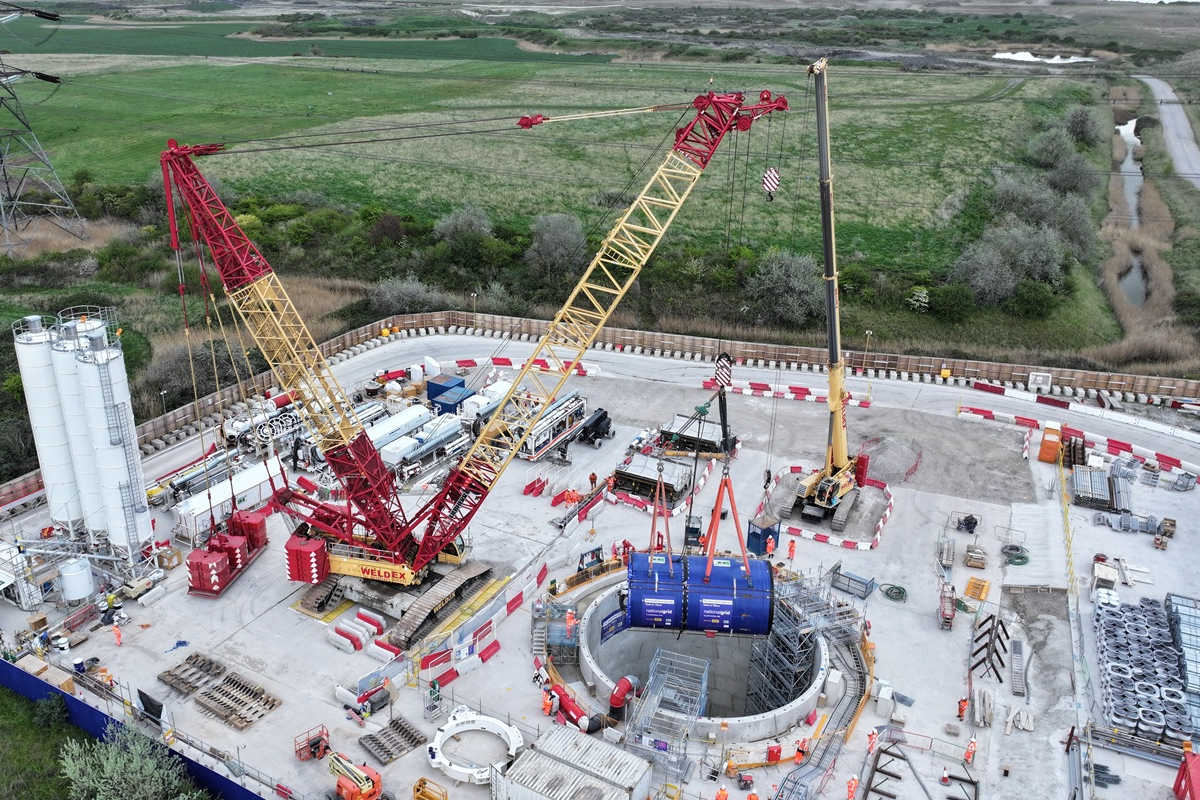
On Sept. 27, 2026, the tunnel boring machine “Caroline” completed the tunnel under the Thames between Tilbury and Gravesend (United Kingdom) by breaking through into the reception shaft. The 2.2-km long tunnel was excavated using a Herrenknecht Mixshield in record time, 49 days ahead of the scheduled completion date. In addition to the tunnel boring machine, Herrenknecht supplied a comprehensive equipment and service package. The launch and reception shafts for the cable tunnel were sunk using Europe’s largest shaft sinking machine (VSM), also supplied by Herrenknecht. The new cable tunnel is a key project in the grid expansion in England and Wales as part of National Grid’s “The Great Grid Upgrade.”
With the breakthrough, the project owner National Grid, the construction joint venture Ferrovial Bemo JV, and tunnel boring technology specialist Herrenknecht AG reached an important milestone in the construction of the 2.2-km long cable tunnel under the Thames for the high-voltage power line between Grain and Tilbury. The tunnel, with an internal diameter of 4 m and an external diameter of 4.50 m, replaces an existing cable tunnel that has reached the end of its service life.
The key to the tunnel’s rapid construction was the close collaboration between National Grid, Ferrovial Bemo JV, and Herrenknecht. Other factors contributing to the project’s success included careful planning, precise knowledge of ground conditions, smooth-running machinery and an experienced construction team.
“Efficient logistics for the continuous supply of tunnel segments and a high-performance separation plant made it possible to consistently utilize the tunnel boring machine’s high advance capacity,” explains Tim Schellhammer, project manager at Herrenknecht. “The Multi Service Vehicle (MSV) supplied by Herrenknecht transported all six segments of a tunnel ring to the machine per trip. There, material for two tunnel rings could be stored on the segment feeder and for another tunnel ring on the rapid unloader. At the same time, the separation plant ensured that the chalk soil, which was transported away in a slurry suspension, was efficiently filtered out and that over 90 percent of the water used could be reused.”
The TBM of the Mixshield type thus achieved consistently high advance rates. Just four and a half months after the start of tunneling, the miners from Ferrovial Bemo JV were able to celebrate the breakthrough into the reception shaft—49 days ahead of schedule. To achieve balanced pressure conditions between the aquifer and the shaft, the breakthrough was carried out as a so-called “wet breakthrough” with the reception shaft completely flooded. The best monthly performance was the installation of 712 tunnel rings and 926 m of advance. The peak weekly advance was 229 m, while the daily peaks were 41 m of advance and 31 tunnel rings installed in 24 hours. In total, over 10,000 tunnel segments and nearly 1,700 tunnel rings were installed.
“The rapid advance of the cable tunnel under the Thames demonstrates that it pays to closely coordinate as many components, technologies, and services as possible for a project,” says Ulrich Schaffhauser, member of the Board of Management of Herrenknecht AG. “With our product and service portfolio, we were able to deliver not only a Mixshield tailored to the operating conditions, but also the corresponding separation equipment and tunnel logistics for continuous tunneling performance.”
The 45-m deep launch shaft in Tilbury on the north bank of the Thames was sunk prior to tunnel boring using Europe’s largest vertical shaft sinking machine (VSM) with a diameter of 15.90 m, as was the 48-m deep reception shaft in Gravesend on the south side of the river. The fact that both the technology for shaft construction and for tunnel boring came from Herrenknecht optimized the technical interfaces in the project—from the insertion of the TBM into the shaft, through the so-called “flying start” of the TBM while the support segments were still positioned on the construction site surface, all the way to the configuration of the MSV.
After the breakthrough, work will continue until the TBM “Caroline” reaches its final position in the shaft and the remaining ring segment construction work can be completed. This will be followed by the dewatering of the flooded shaft. Once this work is complete, the TBM will be lifted out of the shaft and subsequently dismantled, while the project moves into the next construction phase.
Details on the Tunnel Boring Machine
The Mixshield has a diameter of 4,730 mm, is 108 m long, and weighs a total of 464 metric tons. It is designed to withstand the high water pressure of 4.5 bar beneath the Thames in the area where it flows into the North Sea. While water and earth pressure prevail at the cutting face, the rest of the machine is maintained at atmospheric pressure. The highly complex Mixshield—a technology developed by Herrenknecht—offers maximum safety during tunnel construction thanks to precise support of the tunnel face. The TBM is sealed against water pressure 41 m below the Thames using a multi-seal system. For work at the tunnel face—such as changing the cutting tools—the Mixshield features a personnel airlock that allows workers to gradually acclimate to the varying pressure conditions, similar to a scuba dive. Geologically, it is designed to handle a mixed soil composition of chalk and flint.
The excavation diameter can be increased using a hydraulic overcut device. This enables the machine to navigate curves and simplifies course corrections. The tunnel’s curve radius is 350 m. Due to the complex geology, the Mixshield is additionally designed as a “Minigripper” and features so-called rolling fins. This allows the machine to be secured so that the cutting wheel can be retracted if necessary. In addition, the Mixshield is equipped with a drilling rig for preliminary exploration and a telescopic camera, enabling the working face to be inspected without personnel having to work under positive pressure. This allows obstacles in the rock to be detected in a timely manner and the necessary precautions to be taken.
In addition to the TBM, the package for the tunnel construction includes a separation plant, navigation technology from Herrenknecht’s subsidiary VMT, and Multi Service Vehicles that transport the tunnel segments from the launch shaft to the TBM inside the tunnel.
Details on the Vertical Shaft Sinking Machine
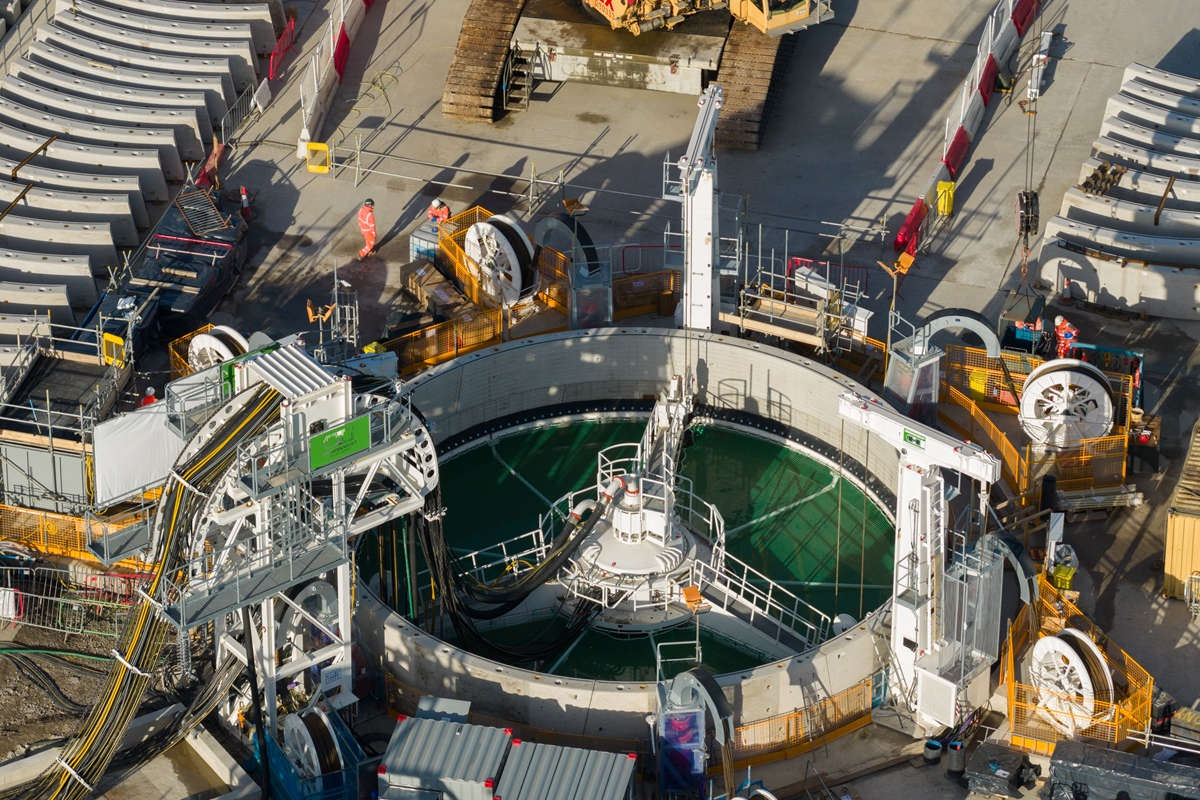
VSM (Vertical Shaft Sinking Machine) technology is particularly well-suited for soft soils with a high water table, as it does not require costly groundwater dewatering. By simultaneously excavating the soil and constructing the ring wall, followed by the lowering of the shaft wall, sinking speeds of up to 2.7 m per day are possible. This method shortens construction time, minimizes environmental impact, and increases safety, as no personnel are required inside the shaft and all work is controlled entirely from the surface.
Herrenknecht supplied a comprehensive equipment package for shaft construction: in addition to the VSM, a high-performance separation plant for processing the excavated material and moulds for ring construction. This is complemented by extensive services ranging from logistics to on-site support.