
Large-diameter Robbins Slurry TBM Breaks Through in Hiroshima
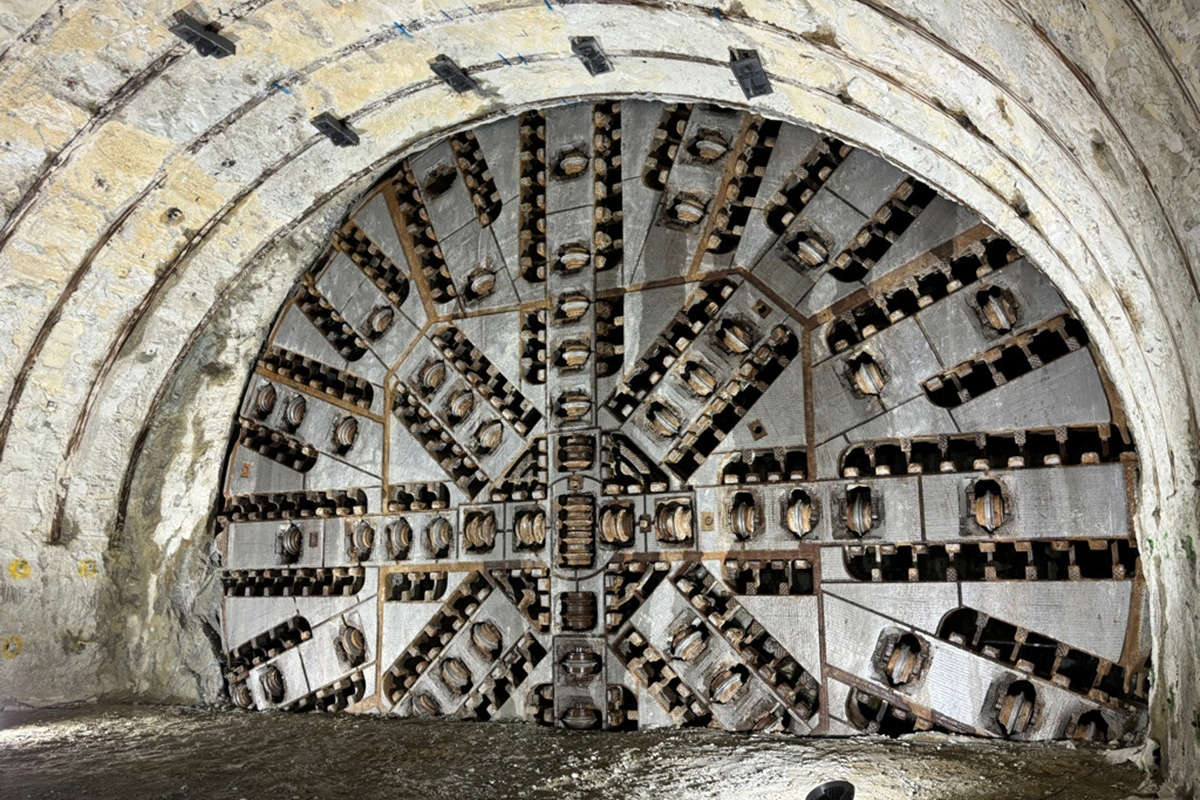
A hard rock heavyweight crossed the finish line this spring with the successful breakthrough of a Robbins 13.67-m (44.8-ft) Slurry TBM in Hiroshima, Japan. The completion of the 1.4-km (0.9-mile) section of the Hiroshima Expressway Line 5 on April 30 is a landmark achievement in challenging geology, and marks the first time a foreign-made large-diameter Slurry TBM has been used to excavate hard rock in the country.
The 2,400 metric ton (2,650 US ton) Robbins TBM was deployed to excavate beneath Hiroshima’s dense urban landscape for the Obayashi-Taisei-Kosei joint venture. The tunnel connects the city’s urban center with a major national highway network and improves access to Hiroshima Airport.
“While there is little track record of large-diameter hard rock drilling with TBMs in Japan, Robbins’ know-how and on-site support for disc cutters, which have a long track record in hard rock drilling, were excellent. We have been able to obtain great results and technical knowledge for future large-diameter slurry hard rock drilling work,” said Mr. Tetsuya Taniguchi, Deputy Director of Obayashi.
The TBM was specially designed to handle the region’s challenging geology, including granite formations with unconfined compressive strengths (UCS) of up to 130 MPa (19,000 psi). The cutterhead and other components were built to withstand these abrasive rock conditions as well as high water pressure.
The machine’s journey began long before its initial cut. Due to the confined urban site and tight transportation restrictions, the TBM was assembled in sections, with each section being split into manageable weights and sizes. Once at the jobsite, which was only 30 m (100 ft) wide by 60 m (200 ft) long, the TBM was reassembled using Onsite First Time Assembly (OFTA) — a process that enabled the team to meet a strict timeline of eight months for machine assembly.
The geology encountered was generally very massive, hard granite — while some fracture zones were expected to appear, crews conducted horizontal boring in front of the face every 50 m (160 ft) and these fracture zones were not found. “In addition, there was a section of low cover directly beneath a residential area, but we were able to pass through it safely by taking the appropriate measures to mitigate environmental impacts such as vibration, noise and ground surface displacement,” said Mr. Taniguchi.
As the team moves closer to bringing the tunnel online, the success of the project proves the effectiveness of Slurry TBMs in challenging hard rock conditions. The completion of the tunnel for the project owner, Hiroshima Expressway Public Corporation, is also a boon to the region, supporting its growing economy and tourist sector.
“From the complex machine launch to breakthrough, we are proud of this tunnel being completed for the city of Hiroshima and congratulate the Obayashi-Taisei-Kosei JV. It will make a huge positive impact for the city,” said Mr. Shinichi Konda, Robbins Chief Engineer.
RELATED: Robbins TBMs Break Through at Delhi Metro DC-07 Project

Comments are closed here.