Longest Stretch of Halkalı-Kapıkule Railway Inaugurated in Turkey
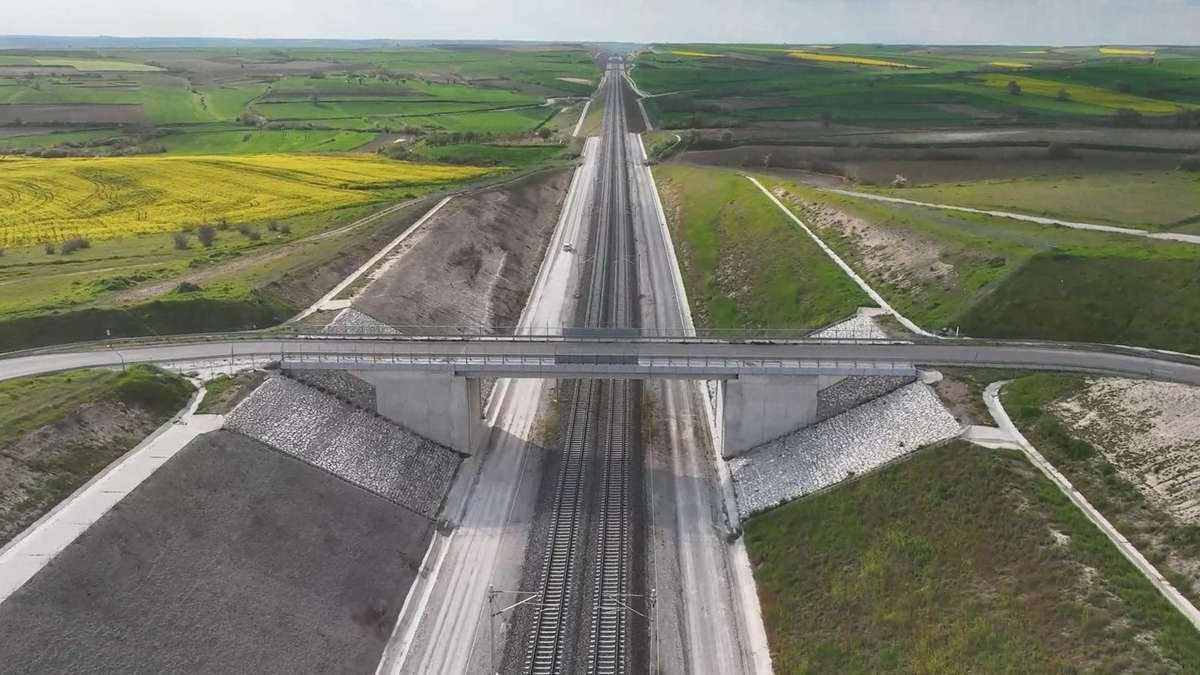
Turkish high-speed rail service has arrived at the gates of the European Union. The longest part of the planned Halkalı-Kapıkule route – a section running 153 km between the logistics and manufacturing hub of Çerkezköy and the rail and road crossing of Kapıkule at the border with Bulgaria – has been inaugurated. It was delivered by an Italian-Turkish consortium led by Webuild and commissioned by the General Directorate of Turkish State Railways.
The ceremony, held at the Babaeski station at mid-point between Çerkezköy and Kapıkule, was attended by President of the Republic of Turkey Recep Tayyip Erdoğan, Minister of Transport and Infrastructure Abdulkadir Uraloğlu, and European Commissioner for Enlargement Marta Kos. An inaugural train ride was conducted between Babaeski and the nearby station of Lüleburgaz, marking the start of operations along what will become one of the main railway borders in the Euro-Mediterranean region.
Once completed, the entire route will be 229 km, stretching from Halkalı, a transportation hub near Istanbul, and Kapıkule at the border near the city of Edirne. Featuring an electrified double-track system and advanced signaling technology, the trains will travel at speeds of up to 200 km per hour, able to carry both passengers and freight.
Once the entire Halkalı-Kapıkule is completed, passenger travel between the two destinations will be reduced from four hours to one hour and 30 minutes, while freight transit times will fall from eight and a half hours to three and a half hours, significantly shortening connections between European markets and Turkey’s main industrial hubs. Capacity along this corridor will also increase substantially: annual passenger traffic is expected to rise from 600,000 to 3 million travelers, while freight capacity will grow from 1.5 million to 9.5 million tonnes per year, reinforcing Thrace’s role as a strategic logistics gateway between Europe and Asia.
For Turkey, the project represents far more than a railway connection. Through Kapıkule, the country’s main land border crossing with Europe, the railway links the strategic ports and industrial hubs of Istanbul, Kocaeli, Tekirdağ and the wider Thrace region with European markets.
The railway will become part of the Middle Corridor, the route linking Asia and Europe through the Caucasus, the Baku–Tbilisi–Kars railway and the Marmaray rail tunnel beneath the Bosphorus, contributing to the development of an increasingly important alternative logistics axis for Eurasian trade. Construction of the Çerkezköy-Kapıkule section included 33 bridges, two viaducts, three cut-and-cover tunnels, around 120 underpasses and overpasses, more than 350 km of track, and the upgrading of the main stations along the route.
With a presence in Turkey since 1966, Webuild has built nearly 15 projects that are emblematic of modern engineering, including the Second Bridge over the Bosphorus and the Osman Gazi Bridge. It was also involved in the construction of the Anatolia Highway, the Keban hydropower plant, as well as key water infrastructure like a treatment plant in Ataköy.