
Breakthrough at Gotthard: Herrenknecht Machine on the Road to Success
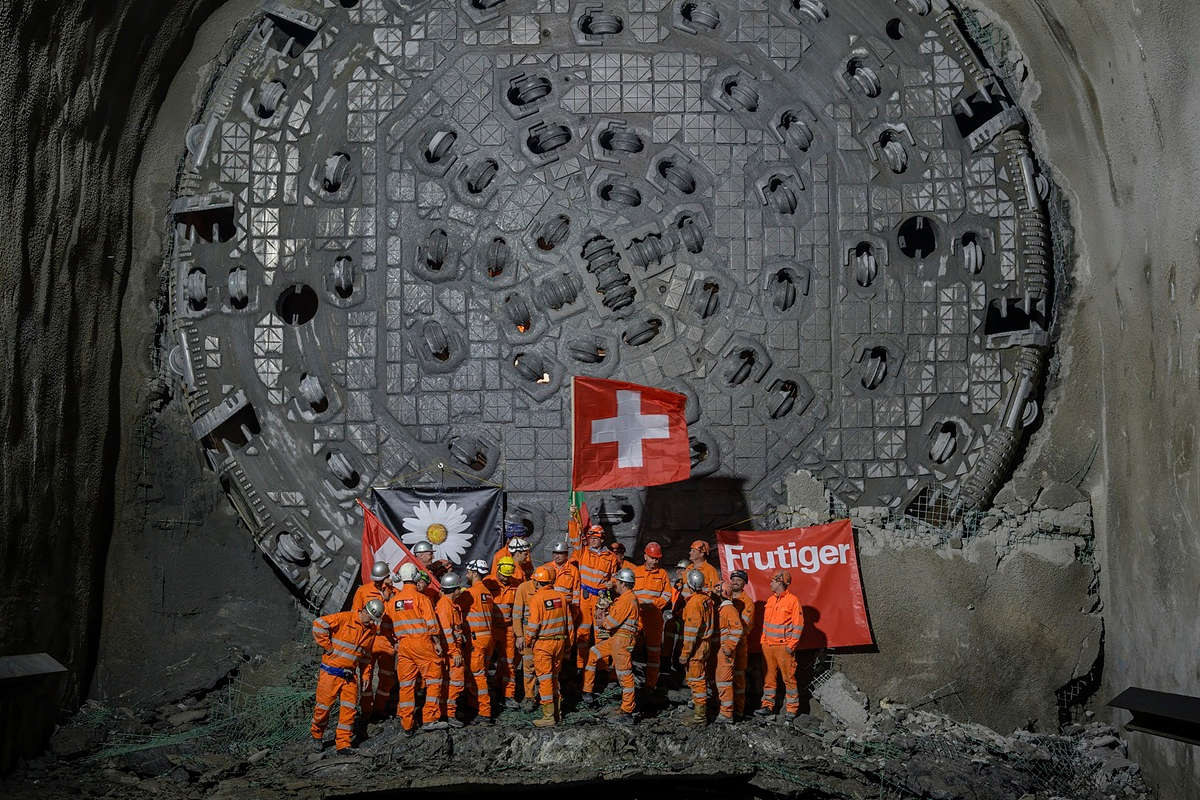
After advancing about 3.8 km through rock that was at times extremely hard and at times brittle, the miners working on the northern section of the second tube of the Gotthard Road Tunnel reached their first milestone with a Herrenknecht tunnel boring machine: On April 29, 2026, they celebrated the precise breakthrough into the previously excavated section of the northern fault zone. From here, they will tackle another approximately 4 km of tunnel construction under the Alps heading south.
“Up to 32 meters a day – that’s a remarkable achievement by the tunneling crews in the extremely hard Gotthard rock.” Dr.-Ing. E.h. Martin Herrenknecht, CEO of Herrenknecht AG, said.
The “secondo tubo” consortium, consisting of partners Implenia and Frutiger, began tunneling in February 2025 in Göschenen in the Swiss canton of Uri on behalf of the client, the Federal Roads Office (ASTRA). The tunnel construction specialists are excavating the northern section of the new second tube parallel to the road tunnel that has been in operation since 1980. To this end, Herrenknecht engineers designed and delivered on schedule a Single Shield TBM (diameter 12,225 mm) specialized for hard rock.
The cutterhead of the machine, christened “Alessandra,” is driven by 15 motors with a total output of 5,250 kilowatts – which is roughly seven times the power of a current Formula 1 race car. The hydraulic thrust cylinders press the rotating cutterhead against the rock face with up to 95,000 kilonewtons – equivalent to the weight of the Eiffel Tower in Paris.
The target of the first tunneling stage – the northern fault zone – had been excavated conventionally in advance. For this approximately 400-m long tunnel section, planners had predicted geological conditions in which mechanized tunneling would not have been efficient. After the breakthrough, the tunnel builders will transport the machine – which is about 100 m long in total – through this cavern before tackling the remaining approximately 4 km to the south. In the coming weeks, the cavern will also serve to thoroughly overhaul the Herrenknecht machine after it has navigated most challenging rock formations to date.
In addition to the sections where the miners were able to achieve peak performance with the TBM, there were stretches with zones rich in quartz or hard, blocky granite that pushed both man and machine to their absolute limits. Johannes Faißt, Herrenknecht project manager for the Gotthard Road Tunnel, explains: “So-called disk cutters are mounted in the rotating cutterhead. As the cutterhead rotates, the disk cutters break up the rock. Depending on the geology, they are subject to specific wear and must be replaced regularly. Here, we were able to provide crucial support for the tunneling operation with high-quality disk cutters from our Schwanau plant and a logistics process that was closely coordinated with our customer.”
Working toward the northern construction section, a tunneling operation coming from the south is advancing for the second tube of the Gotthard Road Tunnel. Here, the tunnel boring machine manufactured by Herrenknecht and operated by specialists from Marti AG had been brought to a controlled stop to excavate a defined tunnel length using conventional methods. This demanding work is now largely complete, so that mechanized tunneling toward the north can resume in mid-May.
From 2003 to 2011, construction consortia at the Gotthard used four Herrenknecht machines to excavate a total of 85 km of tunnel for what was then the world’s longest railway tunnel. The delivery for the Gotthard Base Tunnel ranks among the outstanding milestones in Herrenknecht’s corporate history. This is also confirmed by Matthias Schwärzel, the project management director in charge, for whom it means a great deal to be working with Herrenknecht technology on the Gotthard again: “Tunnel construction in the Alps, and especially at the Swiss St. Gotthard, has always had an emotional component for us.”

Comments are closed here.