
Launch of the 24m-Diameter Shaft Boring Machine ‘Qiming’
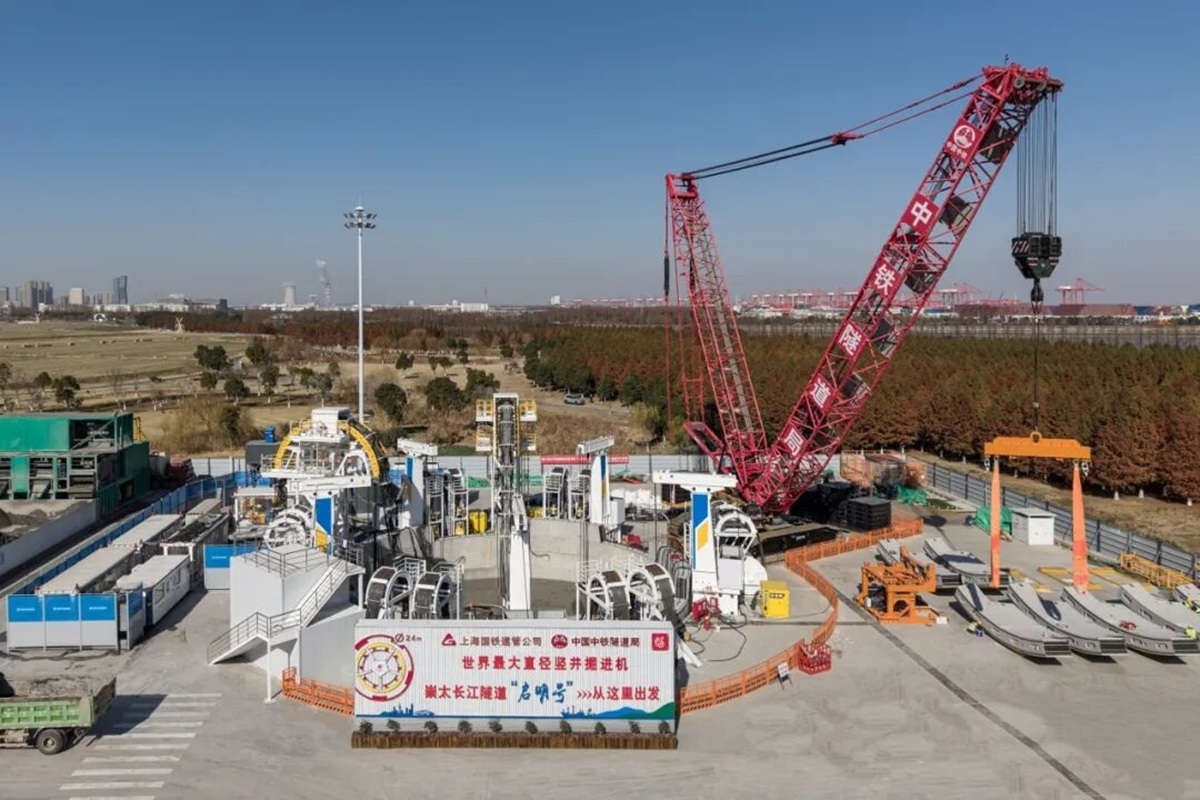
On January 13, 2026, the Qiming, a 24m-diameter shaft boring machine (SBM) jointly developed by China Railway Tunnel Group (CRTG) and China Railway Engineering Equipment Group (CREG), was officially launched at Shaft No. 2 of the Chongtai Yangtze River Tunnel. This launch has ushered in a new era of fully automated boring machine construction for high-speed railway shafts, and also marks the sprint stage for the Linghanghao tunnel boring machine (TBM) to return to construction.
The Chongtai Yangtze River Tunnel has a total length of 14,250 meters, with three shafts along the alignment. Among them, Shaft No. 2 located in Fuqiao Town, Taicang City, serves not only as the maintenance station for the Linghanghao TBM but also as a key hub for TBM reception and relaunch.
The shaft is merely 200 meters away from the southern dyke of the Yangtze River, situated in a riverside floodplain area. It is a prefabricated circular shaft under ultra-deep and water-rich geological conditions. To ensure the safe, rapid and high-quality construction of Shaft No. 2, the project innovatively adopted the fully automated underwater mechanical shaft boring machine Qiming for excavation.
This equipment enables intelligent boring and simultaneous segment assembly under complex conditions such as riverside floodplains, high water pressure and composite ground strata, effectively improving construction efficiency and safety.
The Qiming is equipped with the capability for efficient excavation of extra-large cross-sections and ultra-deep underwater conditions, with an excavation diameter of 24 meters and a maximum excavation depth of 150 meters. This equipment innovatively adopts a double-arm structure, integrating core functions such as excavation, muck removal, and guidance into one. Meanwhile, it integrates multiple innovative technologies, including attitude adjustment and settlement control, and features remarkable characteristics such as strong geological adaptability, high precision in guidance and attitude control, and accurate stratum perception and identification.
Relying on these core technologies, the Qiming can achieve efficient tunneling with “manned monitoring and unmanned operation” under various complex geological conditions, such as soft soil, soft rock, pebbles, and alternating soft and hard rock. This breakthrough not only significantly improves the automation level of shaft construction but also successfully addresses the industry pain points of underwater shaft construction, such as “invisibility, intangibility, inaccurate measurement, and uncontrollability”, effectively reducing the personal safety risks to workers in high-risk operating environments and comprehensively ensuring construction efficiency, quality, and operational safety.
After the tunnel is completed, it will greatly shorten the time and spatial distance between Shanghai and Jiangsu, enable high-speed trains to cross the river without deceleration for the first time, and end the history of Chongming Island, China’s third largest island, lacking high-speed rail access. It is of great significance for building the “Yangtze River Delta on Track”, serving the Yangtze River Economic Belt and the high-quality, integrated development of the Yangtze River Delta.

Comments are closed here.