
XXL Tunnel, XXL Data: How Smart Software Keeps It Moving
The Hampton Roads Bridge-Tunnel (HRBT) Expansion in Virginia, USA, is the largest highway construction project in the state’s history. At $3.9 billion, the project consists of widening a 10-mile highway corridor along Interstate 64 (I-64) to ease traffic congestion into coastal Virginia. The focal point of the project is a 3.5-mile marine crossing over the Virginia harbor, including the boring of two 1.5-mile-long tunnels using a 46ft Variable Density Tunnel Boring Machine (TBM). Faced with the challenge of processing real-time data from more than 3,700 monitoring points across the tunneling operation, the Virginia Department of Transportation selected Tunnelsoft’s TPC for the project. To showcase the practical value of the software, this article explores its application throughout the HRBT Expansion Project by both the field and management teams.
About TPC
Tunnelsoft’s TPC (Tunnelling Process Control) is a versatile data-management and visualization platform widely used across TBM tunneling, pipe jacking, and conventional tunneling projects, offering centralized access to machine and field data in one customizable interface. It captures both real-time sensor data and manual user inputs through its native mobile “Process Logging” module, supporting shift reporting, geological classification, borehole drilling logs, and more. TPC assists project stakeholders by delivering automated reports, monitoring key performance indicators, and sending notifications when critical thresholds are breached, enhancing oversight, risk reduction, and operational efficiency. Its flexibility and support for complex workflows make TPC suitable for both large-scale mechanized TBM operations and smaller conventional tunneling or pipe-jacking sites worldwide.
Harnessing TPC for Field Operations at HRBT
On the HRBT Expansion Project, TPC was used in the field to create shift reports which tracked the utilization of the TBM. The software automatically recorded TBM advance times, the time required for ring building, and general waiting times. The waiting times are then categorized from an existing portfolio and described using comments input directly by the tunnel inspectors working on the TBM. Leveraging mobile devices, inspectors seamlessly integrated site photos into their reports, providing immediate visual context alongside written observations. The shift report was usually refined using TPC desktop but could also be created exclusively via the mobile app, from a cell phone or tablet. At the end of the shift, the incoming data are automatically integrated into the shift reports and auto-distributed by email directly from the software.
The real-time overview of the TBM in TPC allowed data to be tracked live throughout the shift. During the boring operation, inspectors used the TBM dashboard to track parameters such as torque, thrust force, rotation speed, advance rate, tail void grout, tail seal grease, and alignment. The slurry treatment plant (STP) dashboard allowed for tracking of slurry parameters such as densities and flow rates, as well as the filter presses and fill levels in the many holding tanks. Further dashboards were established for annular grouting, face support, survey, GIS, geology, gas monitoring and tail shield. Real-time monitoring of this data allowed inspectors to monitor the entire operation in one place and enabled a quick response in case anomalies were identified.
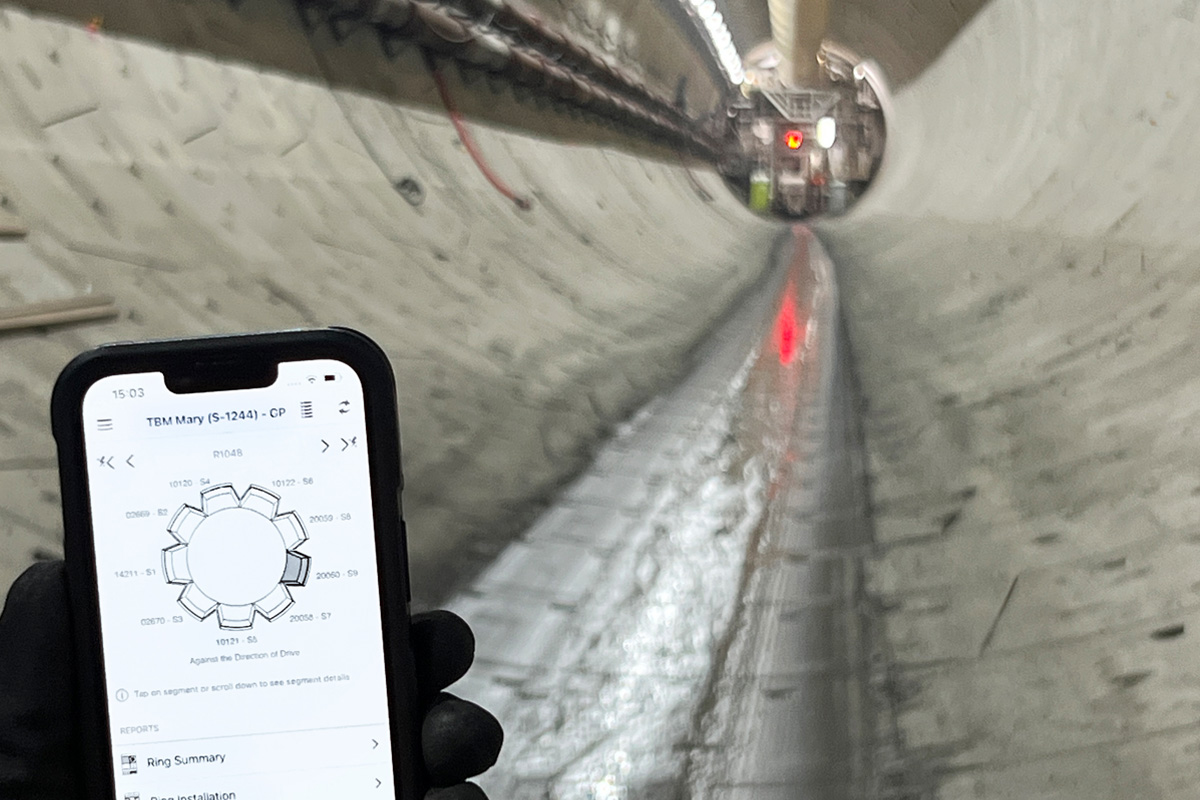
With over 21,000 segments, the HRBT Expansion Project used the Segment Tracker function to help eliminate headaches that come with traditional databases. Inspectors in the field simply scanned a given segment’s barcode, using the mobile app, and were able to see the complete lifecycle of the segment from casting until installation. At the time of the ring build, the segments were scanned into the TPC app and their conformance status was verified. Conforming segments were installed and assigned to the proper ring, while non-conforming segments were identified and replaced prior to being installed. In case any damages (cracks, leaks, spalls, etc.) occurred through the segment handling or ring build processes, a defect with pictures and description was assigned in TPC. At the time of the repair, inspectors uploaded additional notes and pictures to accept the repair directly on the app.
Turning Data into Decisions
On the HRBT Expansion Project, TPC was set up to automatically distribute two sets of reports each morning at 6:00 am, via email, to a customizable group of recipients. The daily executive report summarized the previous day’s production, current TBM location, and total tunnel completion. This brief report was tailored toward the project’s executives and stakeholders. The daily TBM operations report was distributed to the tunnel engineers for a detailed, graphical analysis of any parameters. In addition to the standard key performance indicators such as cutterhead rotation speed, TBM advance speed, penetration rate, cutterhead torque, thrust force, face pressures, and slurry densities, a detailed section was developed for tail void grouting. This allowed the owner’s team to verify compliance with the strict volume and pressure requirements of the specifications. Due to the low tunnel cover in certain areas of HRBT tunnels, it was especially important that the TBM was operated within the established face pressure limits. The trigger level function of TPC was used to implement blow-out and stability pressure limits and send automatic notifications in case they were breached.
Every Monday, a report summarizing the previous week’s production and TBM utilization was generated. This report was used to identify inefficiencies and bottlenecks in the operation by highlighting primary causes of TBM downtime. On the HRBT Expansion Project, the report helped show that the driving factor in the tunnel production was often not the TBM, but instead the STP. By automating these reports and tailoring them to meet project-specific needs, engineers were enabled to be more efficient and dedicate their time to making decisions rather than compiling the data.
In addition to the automated daily and weekly reports, an endless number of custom reports can be created as needed. These reports can be developed using current and historical project data, which is accessible anywhere, anytime in the cloud. The data can be visualized directly in TPC or exported to Microsoft Excel. On the HRBT Expansion Project, engineers used customized visuals to present senior management with objective assessments, supporting decisions on contested contractual matters and reducing project risk.
Bring Your Tunnel Project into the Digital Age
Whether you are a tunnel owner who is looking for oversight or a contractor looking for a more efficient operation, Tunnelsoft’s TPC suite gives you complete control of your tunneling projects. Together with TPC Group Server, TPC Conventional and TPC Pipejacking, the software family supports you for every type of underground project. Backed by in-house tunnel engineering experts, the flexible platform turns mountains of data into clear, actionable insights.
Real-time dashboards with key performance indicators
Automatic reporting and instant notifications
Segment Tracker for end-to-end lining management
Mobile access for on-the-go visibility
Dedicated support from tunnelling specialists
Discover how Tunnelsoft can optimize your next tunnel drive. Schedule your personalized demo today at www.tunnelsoft.com/contact
Lion Nitschke is Assistant Resident Engineer, HRBT Project, BabEng, LLC. Svenja Burgtorf is Tunnel Inspector, HRBT Project, BabEng, LLC.

Comments are closed here.