
Advancing Tunnel Safety Through Smart Monitoring: A Conversation with Worldsensing’s Juan Pérez
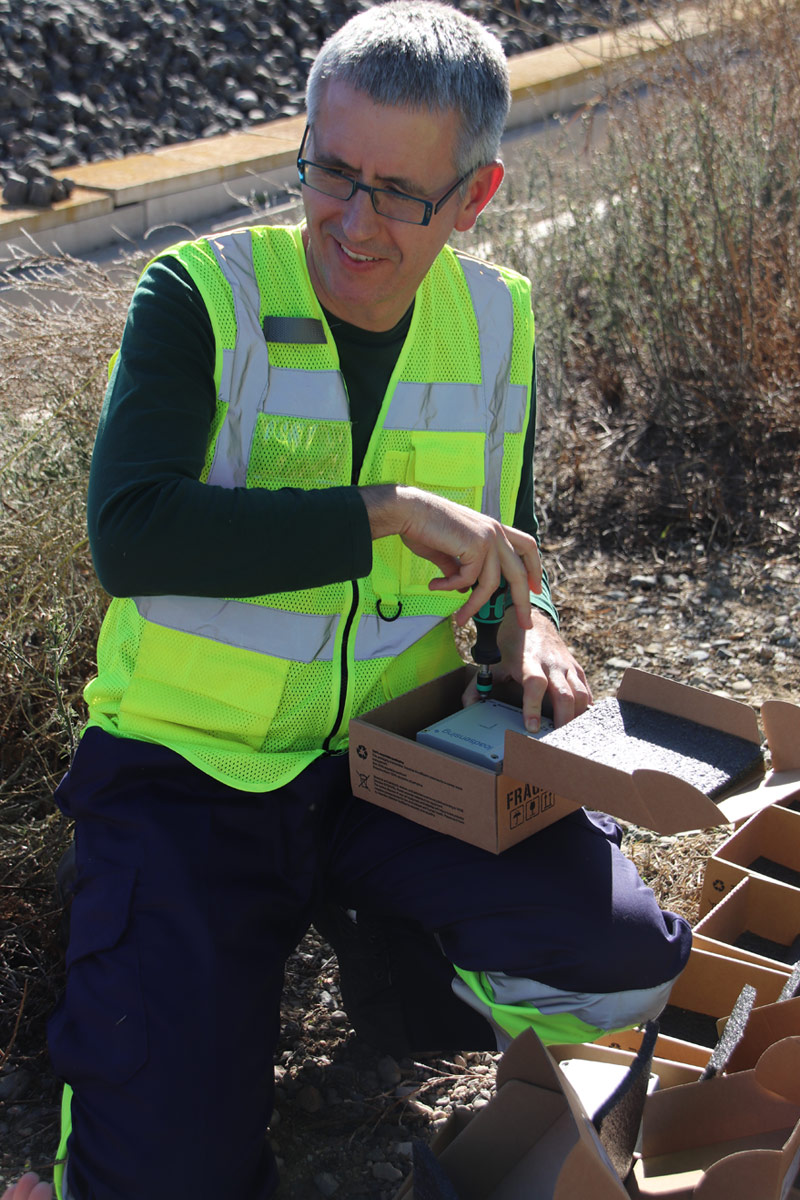
In the world of underground construction, the margin for error is small, and the cost of uncertainty is high. Few understand this better than Juan Pérez Arcas, Head of Instrumentation and Monitoring at Worldsensing, a Barcelona-based company specializing in wireless monitoring systems for geotechnical and structural applications.
Worldsensing was founded in 2008 in Barcelona by engineers Ignasi Vilajosana and Jordi Llosa, inspired by their development of a wireless avalanche sensor system in the Swiss Alps, which marked the company’s first breakthrough in industrial IoT applications. The company quickly evolved into a global pioneer in remote monitoring solutions, focusing on large-scale infrastructure such as mines, tunnels, bridges, and dams.
Pérez, who has devoted more than two decades to understanding how the ground and structures behave, joined Worldsensing in 2013, and has been instrumental in shaping the company’s suite of wireless monitoring tools and systems.
With the right tools, owners, engineers and contractors can help ensure that projects are built more efficiently and safely. TBM interviewed Pérez to discuss the fundamentals of tunnel monitoring and how technology is transforming the field.
TBM: Juan, can you start by sharing a bit about your background and how you came into your current role?
Juan Pérez (JP): Sure. I’m a geotechnical engineer, and I started my career working for an instrumentation and monitoring company in Spain. Much of our work was related to tunneling — projects like the Valencia Metro and the high-speed train tunnels in Barcelona. I joined Worldsensing to help bring practical, field-based knowledge into product development. My goal was to make sure the systems we design truly meet the needs of the monitoring community. Since then, I’ve been involved in defining much of our current monitoring portfolio.
TBM: For someone new to the tunneling market, can you explain the purpose and benefits of a monitoring system?
JP: Monitoring plays a vital role in reducing uncertainty. In tunneling, you never completely know how the ground will behave during excavation. A good monitoring program helps answer key questions about ground movement and structural response. Typically, there are two main objectives: first, to understand how the excavation affects surrounding structures and surface conditions — especially in urban environments — and second, to assess how the tunnel lining performs during construction.
Monitoring data helps engineers detect changes early, manage risk, and make informed decisions before issues escalate.
TBM: What are the most important factors in setting up a tunnel monitoring program?
JP: Ideally, monitoring should be incorporated from the design phase. The designer usually has specific geotechnical or structural questions to answer, and the monitoring plan is developed around those. Ground conditions are a major consideration — whether you’re dealing with soft soils, rock, or mixed faces — as they influence the instruments and installation techniques.
Location is also critical. In cities, for instance, the priority is to ensure that any movement caused by tunneling doesn’t affect nearby buildings or utilities. The sensitivity of those structures — say, a historical monument versus a newer building — will shape the monitoring program’s scope and thresholds.
TBM: What kind of equipment is typically used in these programs?
JP: Regarding instrumentation, you generally have three main groups of sensors. The first group consists of in-ground instruments, such as extensometers, inclinometers, and piezometers installed in boreholes. These sensors measure relative displacement, lateral movements, and pore-water pressure. They can detect changes in the water table and also provide early indications of ground movement before it affects structures.
The second group includes sensors installed at the surface—for example, tiltmeters, laser distance meters, and liquid-settlement systems—which measure the angular distortion of buildings, convergence, and settlement, respectively.
Finally, you have structural instruments such as load cells and strain gauges, as well as sensors that measure the interaction between the ground and the structure, such as pressure cells.
TBM: How has technology changed the monitoring industry over the years?
JP: The biggest change has been automation. When I started, instruments were read manually — technicians would go into the field with handheld units, sometimes closing streets at night to access manholes. That process was slow and sometimes inconsistent.
Today, with battery-operated wireless systems, it’s possible to collect data continuously and transmit it in real time, even from difficult-to-access locations. This automation allows engineers to correlate data directly with tunneling progress, providing a much clearer picture of what’s happening underground.
TBM: Are you seeing more projects include automated monitoring requirements?
JP: Yes, absolutely. In urban tunneling projects, monitoring is now standard practice. Contracts typically include predefined thresholds for allowable ground movement, settlement, or angular distortion, and it’s mandatory to measure these using automated instruments like robotic total stations or wireless data loggers. Owners and contractors have realized that continuous, reliable data is essential for safety and quality assurance.
TBM: What sets Worldsensing apart in terms of data acquisition?
JP: In tunneling, the radio technology is key. Our systems use high-sensitivity long-range radio communication, which can transmit data up to several kilometers — even through the curved geometry of tunnels. This is a major advantage during construction when machinery or the TBM itself can obstruct signals. We also design repeaters that can be installed inside tunnels to extend the network and ensure connectivity without needing wired infrastructure. What really differentiates Worldsensing is that all our hardware and software are developed in-house by our engineering teams. That allows us to innovate quickly and ensure compatibility and reliability across our product line.
TBM: How are contractors and owners using the data once it’s collected?
JP: Typically, data from monitoring systems is visualized through specialized software platforms that all stakeholders — contractors, designers, and owners — can access. The engineer plays a key role in interpreting the data. If measured movements exceed expected values, they may recommend remedial actions such as adjusting excavation rates, modifying support systems, or reanalyzing numerical models. Monitoring data is also used to verify tunnel lining performance and optimize construction methods — for example, determining the required density of rock bolts or the thickness of sprayed concrete.
TBM: Can you give us an example of how this technology is being applied?
JP: One example is the Lyon–Turin high-speed rail tunnel between France and Italy. It’s a massive project — over 50 kilometers long — combining both TBM and drill-and-blast excavation. The ground conditions are very challenging, so real-time monitoring is essential. The monitoring company on that project uses our wireless systems to collect data automatically. This information has directly influenced design adjustments, such as increasing tunnel lining reinforcement in some areas based on measured deformations.
It’s a good illustration of how reliable, automated data collection helps teams make better engineering decisions in complex environments.
TBM: What advice would you give to owners who are planning their first tunnel project?
JP: Think about monitoring early — during design, not after excavation starts. The monitoring plan should reflect not only what you need to measure, but how you’ll collect and transmit that data throughout the project. In many cases, wireless systems are the most practical choice because they can be deployed from the very beginning, without the need for complex signal and power cabling installations—with their required protection—which often do not adapt well to the constantly changing environment of a tunnel under construction. It’s also important to ensure that the system will provide reliable data during construction, when conditions are constantly changing. Choosing radios with long range and high sensitivity — like LoRa technology — ensures consistent connectivity even in deep or curved tunnels. Ultimately, the goal is to make data accessible, continuous, and actionable so that engineers can make decisions with confidence.
TBM: Any final thoughts on where tunnel monitoring is headed?
JP: On the one hand, it is essential to automate instrument measurements immediately after installation, so that the most relevant information is captured from the start. This means using wireless technologies that can adapt to the changing environment of a tunnel under construction, and even embedding data loggers in the precast segments.
On the other hand, the future is about integration and the combination of different technologies. We are seeing solutions such as robotic total stations, GNSS, satellite InSAR, and wireless geotechnical sensors coming together to provide a complete picture of ground behavior. For example, at Worldsensing we are leveraging a GNSS Meter that measures absolute 3D ground displacements and serves as a reference point for other instruments and monitoring techniques. In this device, we have incorporated advances originally developed for fields such as autonomous vehicles and drones, and applied them to geotechnical monitoring.
By merging these innovations with our expertise, we can deliver systems that help engineers manage complex projects more safely and efficiently. That’s the direction the industry is going — more connectivity, more data, and ultimately, more insight.


Comments are closed here.