Hudson River Ground Stabilization Project
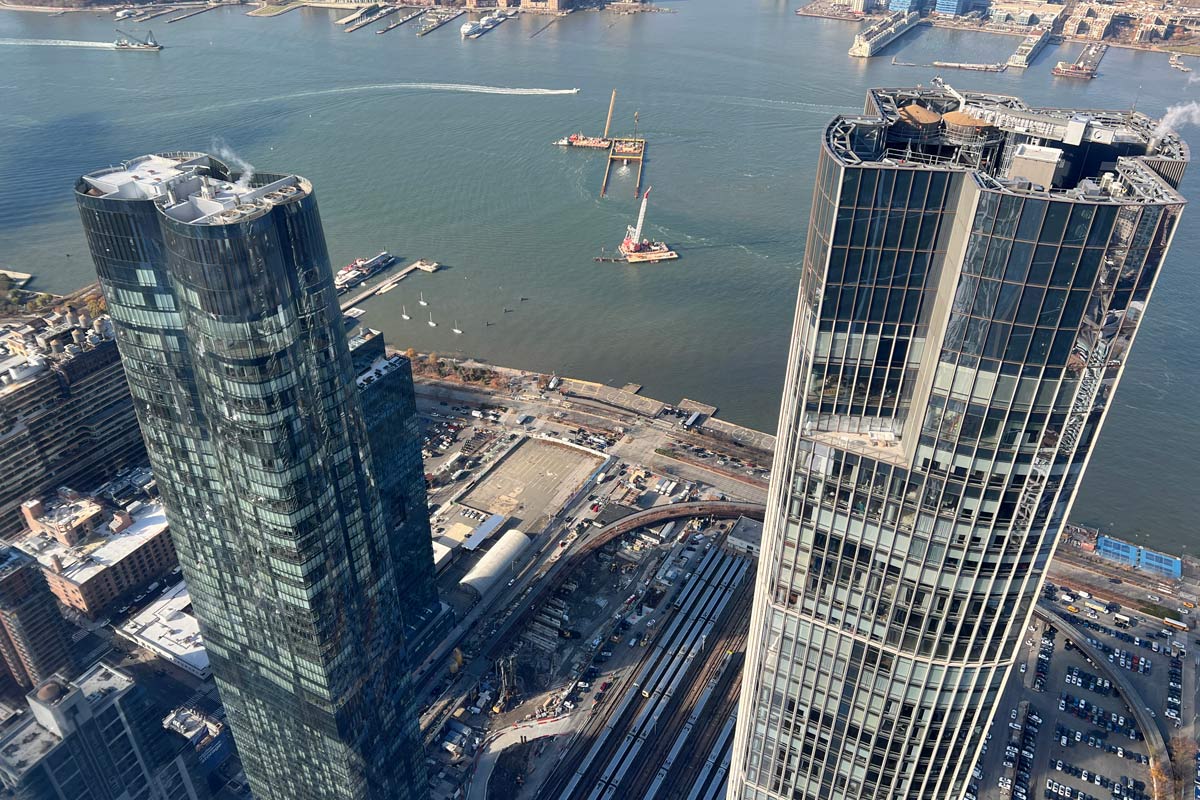
Soil Mixing Provides Ground Improvement for Future Tunneling
By Dennis Boehm and Jim Morrison
The Gateway Program will deliver critical rail infrastructure projects between Newark, New Jersey, and Penn Station in New York City, along the Northeast Corridor (NEC). The NEC is the most heavily used passenger rail line in the United States, with more than 2,000 trains per day carrying approximately 800,000 daily passenger trips across eight states and Washington, D.C. The Hudson River Tunnel is a key component of the overall Gateway Program being delivered by the Gateway Development Commission focused on delivering a new twin tunnel system from New Jersey and under the Hudson River into Manhattan.
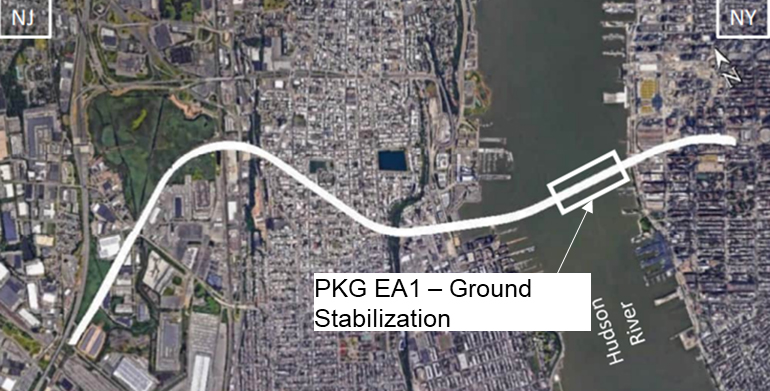
The Hudson River Tunnel Program will upgrade and provide reliability for rail infrastructure assets that, in many cases, are over 110 years old. The Hudson River Ground Stabilization Project (HRGS) is one of several strategic early works contracts being executed to facilitate successful delivery of the overall Hudson River Tunnel project safely and on time.
Alignment challenges
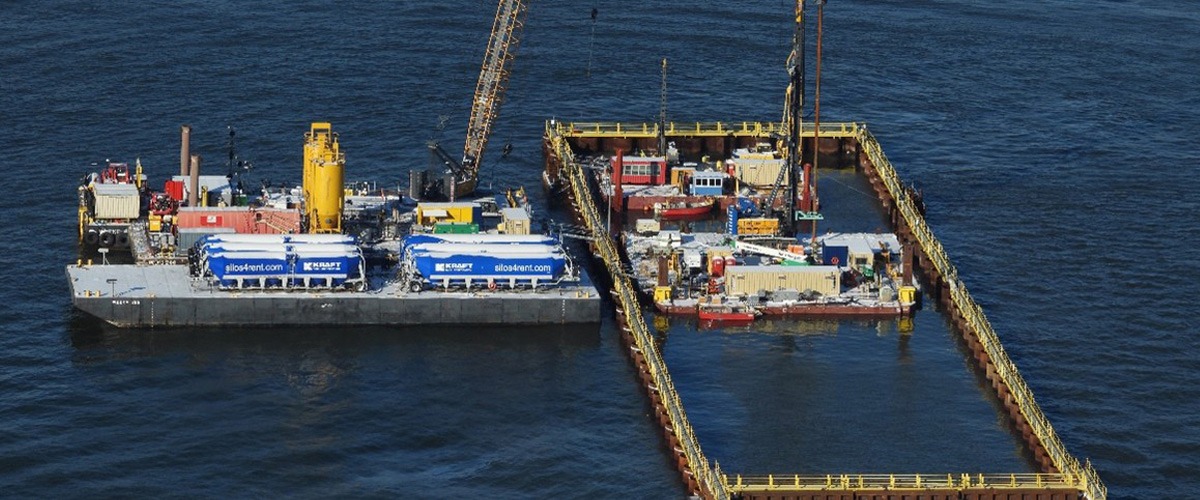
The new alignment of the Hudson River tunnel crosses from Hoboken, New Jersey, on the west and lands in Pennsylvania Station in New York (PSNY) on the east side of the Hudson River. The profile of the tunnels shallows up in respect to the river mudline as the alignment approaches the New York shore, creating a challenge for tunnel installation. The geotechnical conditions in this area of the project consist of soft cohesive soils and other river sediments further challenging the installation of the tunnels. Boring through these conditions would create significant challenges for the tunneling contractor, which led the designers to create a block of modified soil in the shallowest part of the alignment. The soil improvement work will enhance the strength of the soil 1,200 feet long, 110 feet wide and approximately 55 feet thick beneath up to 65 feet of water in the Hudson River.
Block Geometric Requirements
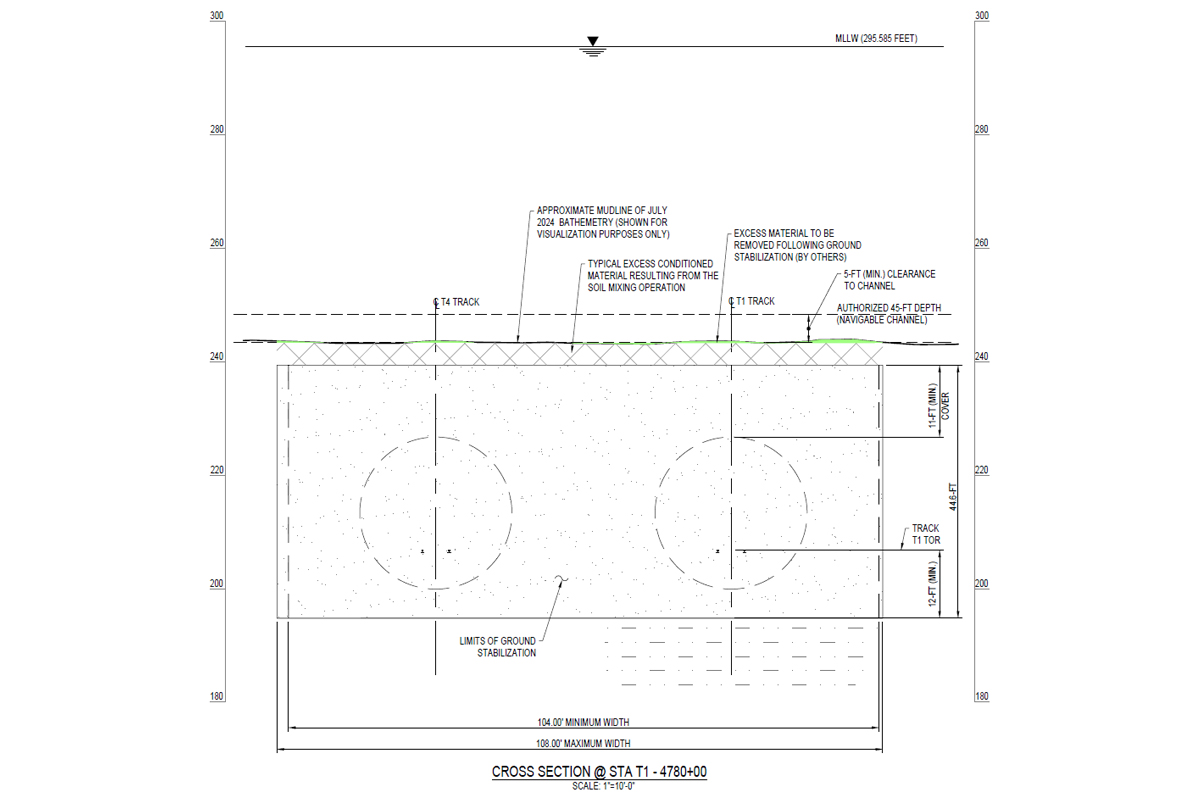
Meeting the design challenges of the site meant that the proposed block of improved soil has to provide a minimum cover above the top of the future tunnels to provide for safe construction and secure tunnel operation and extend 5 feet below the tunnel bottom. Additionally, the improved block needed to provide a minimum thickness of improved ground 12 feet outside either tunnel. The treated ground would need to be strong enough to provide safe tunneling and not too heavy or not too light, which could result in the block moving over time. For these reasons the designers chose a strength range of 100 to 800 pounds per square inch for the unconfined compressive strength of the improved ground. To reduce risk of settlement of the strengthened block a unit weight range of 85 to 115 pounds per cubic foot was selected. The block is intended to be continuous and contiguous across the width, length and depth of the strengthening.
Choice of Wet Soil Mixing to Improve Ground
Keller chose to improve the block of soil under the Hudson River using the Wet Soil Mixing (WSM) process. Although the specifications allowed the use of dry mixing solutions, WSM provided the necessary process control and larger tooling needed to make the project feasible within the time allotted to perform the work.
The WSM process uses cementitious binders mixed with water to form a slurry that is injected through the mixing tool as it advances through the target soil. As the mixing tool is advanced from top to bottom of the targeted soil, the binder slurry is mixed with the soil in a controlled manner to produce soilcrete elements.
In general, these elements are typically cylindrical, constructed with large diameter, single axis mixing, and need to be overlapped to provide the needed continuity. Keller chose to use an innovative design of elements to treat the targeted soil at the site that minimized this waste and reduced the work’s carbon footprint by 20% compared to the conventional approach.
The proper overlapping of columns can be difficult to control particularly at greater depth and is significantly complicated when performed from a floating work platform that can sway slightly with incoming and outgoing tidal currents. Additionally, the overlapping of columns is an inherently wasteful process, and the Gateway Commission is very focused on minimizing the carbon footprint of the work.
Installation of the Individual Elements
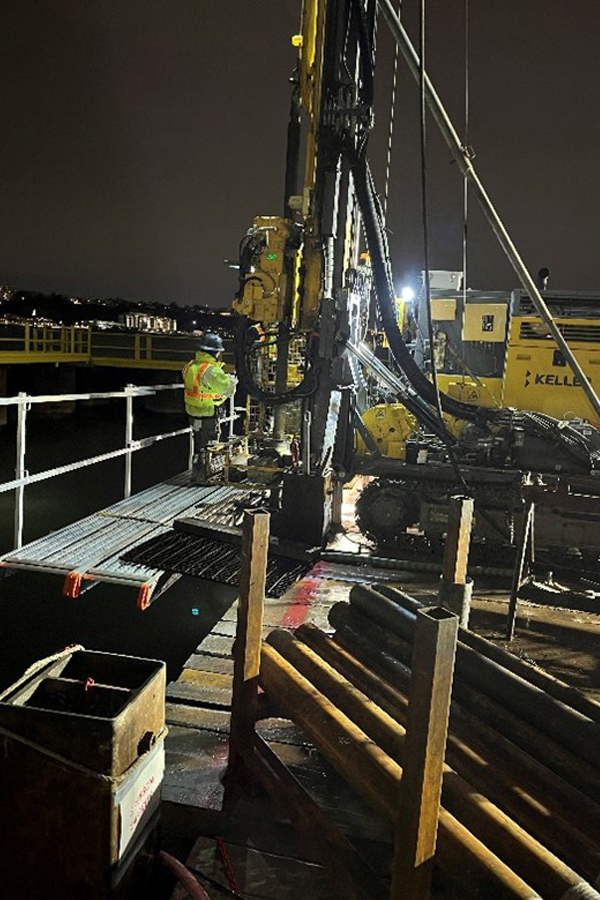
Working from within a containment structure designed and installed by Weeks Marine, a Kiewit company, WSM elements are installed from a floating platform using conventional rotary drilling equipment with extended capabilities to reach the deepest elements, some 102 feet below the river surface. Individual elements are installed in rows within the containment structure to control and contain the swell created by the WSM process. Elements are installed in a primary-secondary fashion that allows full treatment of the design prism of improved soil.
Tooling Choices
The tooling used to perform the WSM was designed by Keller and custom fabricated for the project to assure thorough mixing of the targeted soil while minimizing the number of elements installed on the project.
Since verticality is crucial when creating a stabilized block of contiguous mixed soil, the tooling is designed to be rigid to minimize flexure while installing the WSM elements to the needed depths. A separate tool was designed to install the primary and secondary elements. These tools are interchangeable during a mixing shift to minimize production disruptions and meet the demanding schedule.
Measuring Installed Elements
The maximum depth of mixing on the project is over 100 feet, and the drill rig performing the work sits on a floating platform within the containment structure. This containment structure provides a safe haven for the mixing from the swift currents of the Hudson River but doesn’t keep the floating platform from rising or falling during the daily tide fluctuation.
The changing elevation of the work platform can be significant on this section of the Hudson, which has a tide differential of over 5 feet. To accommodate the tide during construction of each element, Keller is using real-time GPS elevation to adjust the depth of each element in real time to ensure proper mixing depth has been reached.
All other measurable parameters of the installation process are recorded using Keller’s onboard data acquisition system, which records vital installation parameters every second during construction. While vertical control is provided by GPS and parameters are recorded for each element, special sensors installed on the mixing tool record verticality during mixing so that as-built information can be used when positioning secondary installed elements.
Testing Installed Elements
Installing the elements through 65 feet of Hudson River and then through 55 feet of soft compressible clay is only half the battle. Measuring how well they were installed and confirming continuity between elements is where the rubber meets the road.
Several quality control checks are made to ensure the elements are continuous from top to bottom, which include wet grab sampling and continuous coring.
During production and before the elements reach initial set, a down-hole sampler is lowered into the previously mixed element, and samples of the mixed material are collected, brought back to the surface, and cast into cylinders that can be tested for unconfined compressive strength (UCS) following set.
This information provides an early indication of quality and initial guidance on selecting which element to core. Coring is performed on several elements throughout the project to provide information on the continuity of the mixed element and provide samples for UCS testing and unit weight determination.
Project progress
To date, the project team has completed the test section work and is proceeding with production work, with roughly 15% of the project completed. The work is designed to progress in stages, wherein only 600 feet of the containment structure can be installed in the river at any given time. This restriction is further challenged with in-water work seasons, which only allow work in the river, outside the containment structure, from July to January each year.
The work is expected to be completed in late 2026, with tunneling following on a separate contract. If you are ever in the NY/NJ area, make sure you stop by and say hi, or wave as you pass the project on one of the river ferries heading into Manhattan!


Comments are closed here.