
Metro Selects Locally Preferred Alternative for Sepulveda Transit Corridor Project
The Metro Board of Directors on Jan. 22 unanimously approved Metro staff’s recommendation for a Locally Preferred Alternative (LPA) for the Sepulveda Transit Corridor Project. The decision on the LPA – the project’s route and the type of train it will use — is a major milestone in planning the long-awaited, high-capacity rail connection between the San Fernando Valley and West Los Angeles.
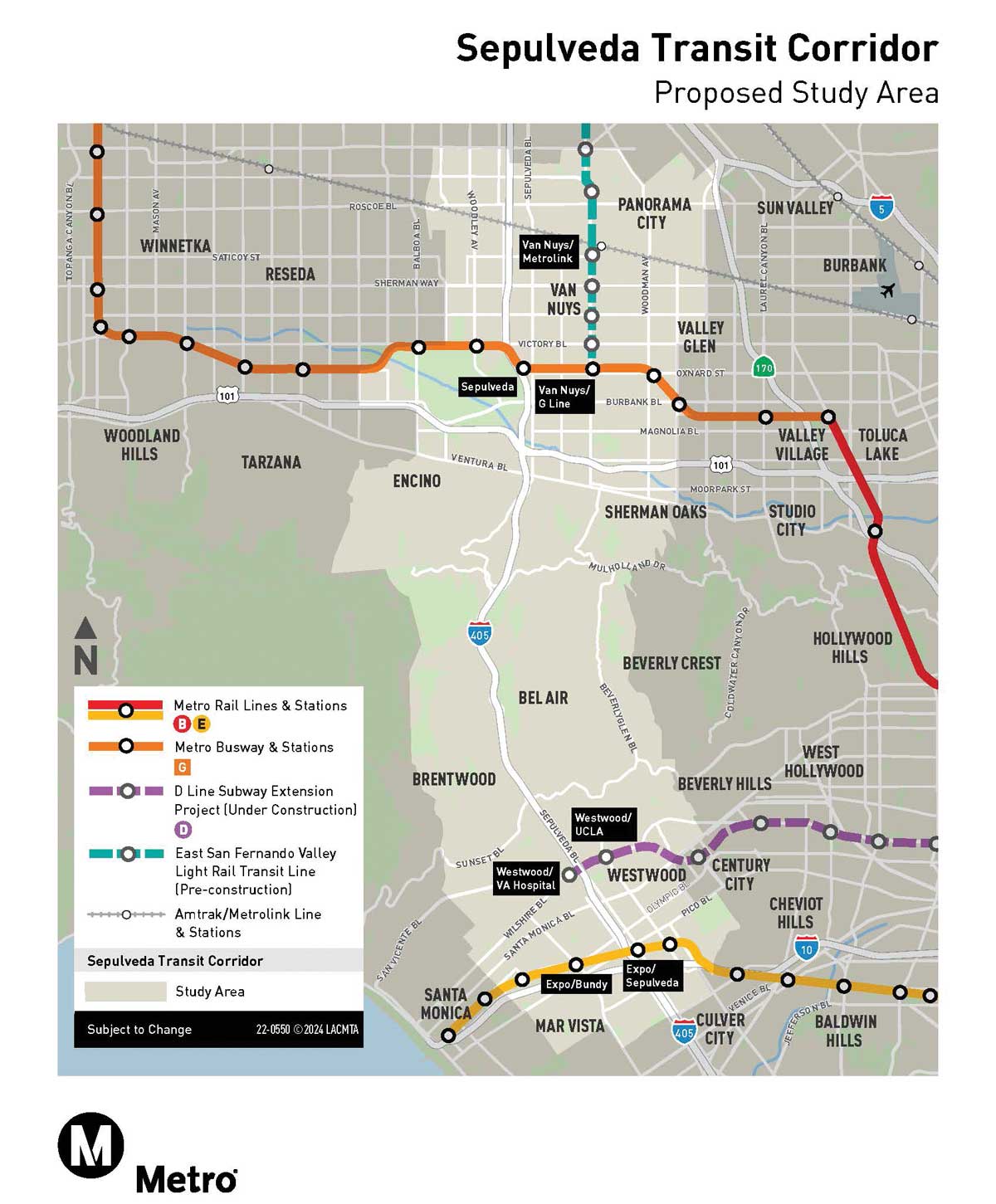
Metro had been studying five alternatives for the project – three were heavy rail and two were monorail. Following extensive technical evaluation and public input, Metro staff recommended Modified Alternative 5 as the LPA that borrows elements from Alternatives 5 and 6. This option would deliver a fully underground heavy rail subway — similar to Metro’s B and D Lines — running between the Van Nuys Metrolink Station in the Valley and the E Line’s Expo/Sepulveda Station on the Westside.
At the Van Nuys end, the project would also connect riders to the Metro G Line and the future East San Fernando Valley Light Rail Project that will run between Van Nuys, Panorama City, Arleta and Pacoima. On the Westside, riders would have a station on UCLA’s campus and easy transfers to the D Line and E Line.
Quick project background
Those who have driven anywhere near the 405 corridor know that connecting the Valley and Westside via a high-capacity and fast transit line is critically needed.
Traffic congestion through the Sepulveda Pass is terrible and expected to get worse. This project would provide a safe, fast, reliable 20-minute trip from end-to-end; the same trip by car often takes 40 to 80 minutes and is unpredictable because of traffic. This is the reason we view this as a generational project.
Why Modified Alternative 5?
Modified Alternative 5 builds on key elements of Alternatives 5 and 6 studied in the project’s Draft Environmental Impact Report (EIR).
Features include:
- A single-bore tunnel, which reduces areas of surface construction
- Trains capable of running every 2.5 minutes at peak times
- A route along Van Nuys Boulevard in the Valley rather than Sepulveda Boulevard, reducing project length and anticipated costs
- No need to build a costly ventilation shaft in the Santa Monica Mountains.
Proposed Phasing
As with nearly all large Metro rail projects — including the B/D Line subway and the A and E Lines — staff recommended phasing construction so that segments can be built as funding becomes available.
For the Sepulveda Transit Corridor, staff propose focusing first on an Initial Operating Segment (IOS) between the G Line in Van Nuys and the D Line on the Westside.
This IOS would allow riders to make direct transfers easily from multiple rail and bus lines, would hugely improve transit travel times and make taking transit faster than many drive times in the Sepulveda corridor.
What Riders Can Expect
Modified Alternative 5 responds directly to key concerns raised by the community and stakeholders in the planning process, including the 8,000-plus public comments received during the Draft EIR review.
Key project benefits include:
- Fast travel times: The trip between the G Line in Van Nuys and the D Line in Westwood would take about 10 minutes.
- Strong regional connectivity: Direct connections to Metrolink, the G Line, D Line, E Line, and the future East San Fernando Valley Light Rail Project, as well as local bus lines.
- Stations at major destinations including on the UCLA campus.
- Cost effectiveness: Alternative 5 ranked as the second most cost-effective option in the Draft EIR, and the modified version presents further opportunities to reduce costs.
- Addresses community concerns: No costly Santa Monica Mountains ventilation shaft would need to be built and no elevated structures would be needed in the Valley.
Cost and Funding
The preliminary capital cost estimate for Alternative 5 is $24.2 billion (in 2023 dollars). This estimate will be updated to reflect Modified Alternative 5 as design refinement progresses.
Initial funding for a Sepulveda project was in the 2008 and 2016 sales tax measures – Measure R and Measure M, respectively – both of which were approved by more than two-thirds of L.A. County voters.
Additional funding to build the project will be required – as is the case with all our major transit projects. Metro anticipates pursuing a combination of federal, state, and local funding, along with potential private financing through a public-private partnership (P3).
What Comes Next
With the LPA now approved, staff can begin refining the project’s design, including:
- Evaluating project phasing strategies
- Defining an updated maintenance and storage facility approach
- Identifying value-engineering opportunities
- Further assessing a P3 delivery approachRefining design elements to improve connectivity, including the G Line interface in Van Nuys
With the LPA selected, the environmental review process will continue, along with ongoing community outreach and additional opportunities for public input.
Here is the Metro staff report.

Comments are closed here.