
Technical Considerations of Subsurface Placement of Small Modular Reactors (SMRs)
1. Introduction
Small Modular Reactors (SMRs) are a rapidly developing class of nuclear power systems intended to deliver reliable, low‑carbon electricity with reduced construction risk compared with conventional large nuclear plants. Whereas traditional nuclear stations are often gigawatt‑scale facilities, SMRs emphasize standardized designs, factory fabrication, modular installation, and the option to expand capacity incrementally. Underground placement has been proposed to enhance physical protection, provide passive radiation shielding, and improve resilience to external hazards such as hurricanes and earthquakes while offering stable boundary conditions that may support long‑term structural and power performance. Despite these benefits, subsurface placement adds constraints that are uncommon in surface nuclear projects. Underground SMRs require large excavations, complex access and ventilation networks, long‑term groundwater management, and watertight spaces. Such projects are as much a geotechnical and underground construction project as they are a nuclear power plant, because the surrounding rock mass becomes an active part of the facility’s engineered environment.
This paper synthesizes SMR power generation characteristics, underground siting approaches, advantages and disadvantages, and the governing technical aspects of fully or partially underground SMR design and construction.
2. What are SMRs?
SMRs are generally defined by two features: 1) smaller unit electrical output than conventional nuclear reactors, and 2) modular manufacturing and construction strategies. SMRs include several technology families that differ by coolant and core design, including light water reactors (LWRs), high‑temperature gas‑cooled reactors (HTGRs), fast reactors (e.g., sodium‑ or lead‑cooled), and molten salt reactors (MSRs).
A key parameter for SMRs is their typical generating capacity. Common SMRs produce approximately 50–300 megawatts electric (MWe) per module, depending on design and intended application. Although smaller than the conventional reactors, this output is relevant and can be scaled up as needed by deploying multiple modules at one site. The modular scaling can align capacity additions with power grid needs, reduces the financial exposure of a single large construction project, reduces risks, and enables staged commissioning that improves delivery schedule.
All reactor systems produce heat in the core and convert it to electricity through steam or other conversion systems. LWR-based SMRs typically achieve efficiencies similar to conventional nuclear plants, while higher-temperature SMRs may improve efficiency and provide useful industrial process heat. However, reactor power rating affects underground feasibility, since higher output requires larger heat rejection systems, more auxiliary infrastructure, expanded ventilation needs, and larger excavations. As a result, LWR-type SMRs are generally better suited for underground siting.
3. Underground Siting Concepts for SMRs
3.1 Fully underground SMRs
Underground siting places the reactor and key support systems underground in caverns with access and support tunnels, and shafts. The layouts typically include a reactor cavern housing the modules and containment boundary, auxiliary/service spaces for mechanical and electrical systems, access tunnels, construction shafts, a ventilation system, and supporting facilities. Some functions remain surface-dependent, especially the electrical grid connection and the heat rejection requiring shafts and robust interfaces between the underground and surface structures.
Fully underground SMRs provide greater physical protection and reduced exposure to surface hazards, but it requires intensive geotechnical site characterization to determine its suitability, complex excavation sequencing, robust structural support, and long-term underground operations planning. Designs must address rock–structure interaction, seismic response, potential faulting hazards, and deformation compatibility while meeting Nuclear Regulatory Commission (NRC) regulatory and permitting requirements.
3.2 Partially underground SMRs
Partially underground SMRs offer a practical middle ground between surface plants and fully underground cavern facilities. In this approach, the reactor module, portions of containment, and selected safety systems are placed below grade, while balance-of-plant elements remain at or near the surface. Designs of partially underground siting may use below grade reinforced-concrete structures, bermed buildings, or subsurface vaults connected to surface facilities. This configuration provides key benefits of underground siting such as improved security, shielding, and resilience to external hazards without the complexity of deep rock excavation. Construction logistics are typically easier because access is closer to the surface. Also operation and maintenance are more direct, and emergency egress distances are shorter. However, major engineering challenges remain, including hydrostatic uplift, potential differential settlement, potential groundwater intrusion, long-term waterproofing, and durability of below grade structures.
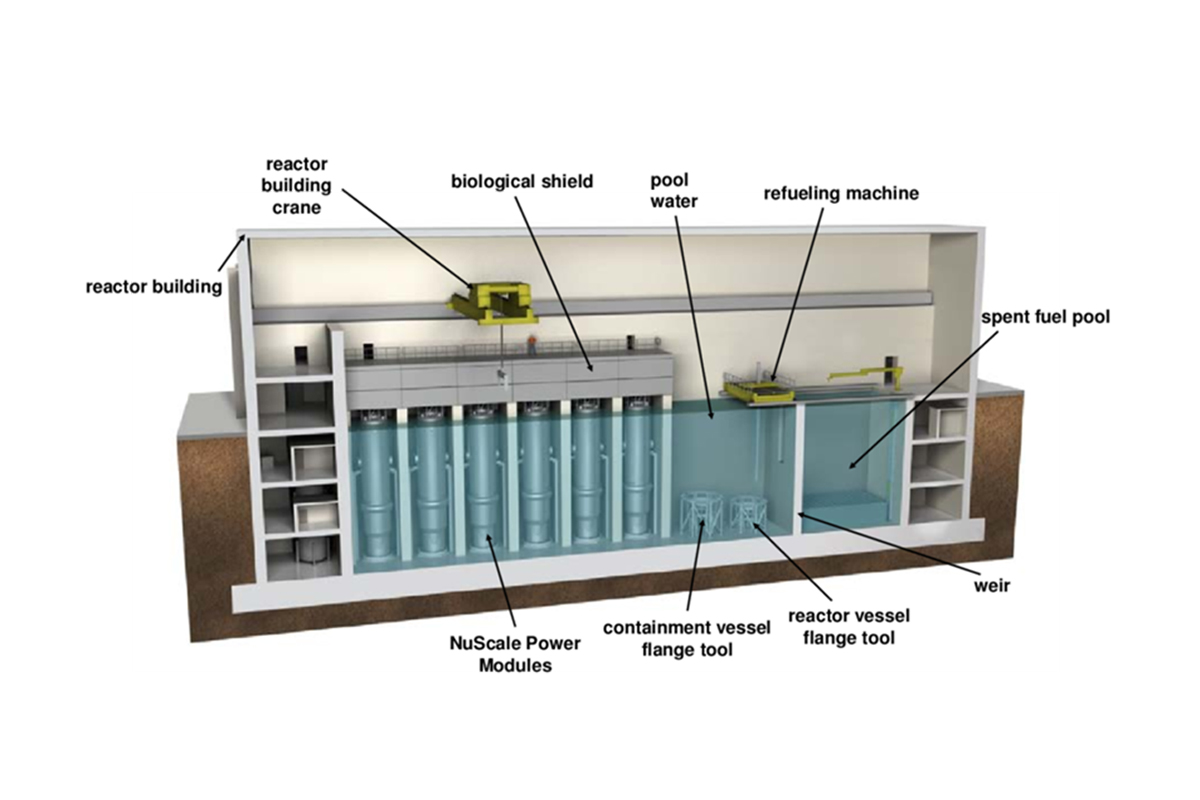
Figure 1 shows the NuScale “VOYGR” SMR configuration, a partially underground SMR facility.
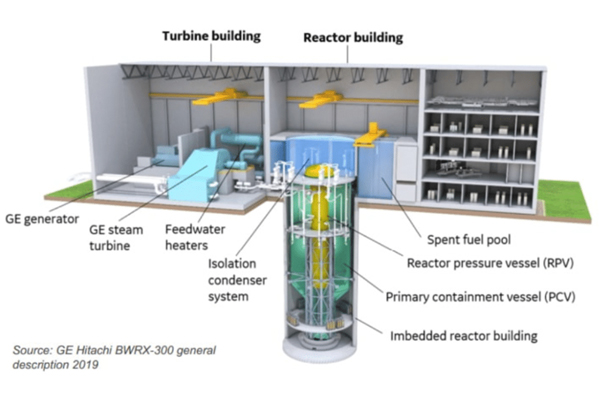
Another partially underground concept is the Rolls-Royce SMR Power Station, a UK-developed large design rated up to 470 MWe and being pursued in several European countries, though full configuration details remain unavailable. In North America, GE Hitachi’s BWRX-300—developed by GE and Hitachi—has attracted interest from multiple utility companies and Canadian provinces, with the design undergoing review and licensing engagement with the Canadian Nuclear Safety Commission (CNSC). See Figure 2.
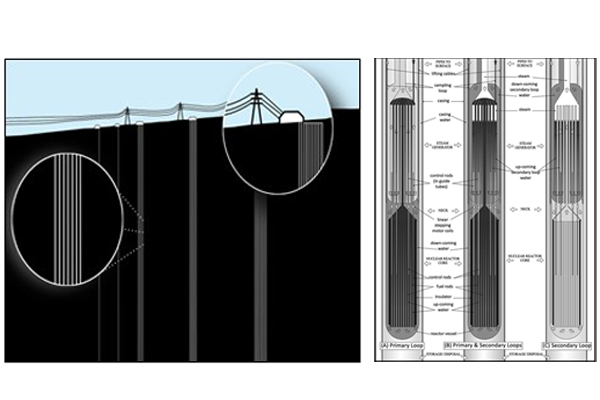
In contrast, fully underground concepts such as Deep Fission’s “Gravity Reactor” propose deploying a small reactor in a deep vertical shaft approximately one mile underground. The Deep Fission module is small about 9 meter (29.5ft) long and less than one meter (3.3 ft) in diameter. It is designed to provide around 15 MWe per unit while leveraging geological depth for protection and isolation. Deep Fission describes a modular clustering concept in which multiple 15‑MWe units could be deployed on a single site to create larger power blocks. Figure 3 provides illustration of the Deep Fission Gravity Reactor concept.
4. Applications of SMR Projects
Only a limited number of SMRs are currently operating worldwide (China and Russia), but several projects are advancing from licensing into construction. Major developments include Canada’s Darlington BWRX-300 (the first of four units began construction in 2025), China’s 125 MWe Linglong One, TerraPower’s 345 MWe Natrium reactor in Wyoming, and Russia’s 300 MWe BREST-OD-300.
Near-term U.S. projects include Palisades SMR in which Holtec International is developing two SMR-300 units at the Palisades site in Michigan aiming for operation by 2030; Hermes Reactor, a non-power demonstration reactor by Kairos Power in Tennessee; and Abilene Christian University’s Seawolf SMR; in addition to Project Pele mobile microreactor being developed by the US Department of Defense. Furthermore, several European countries are in negotiations or contracted with Rolls-Royce SMR to implement projects in the UK, Czech Republic, Sweden, Hungary, Poland, and Finland among others with anticipation of having on-line systems in 2030s.
5. Advantages and Disadvantages of Underground SMRs
Advantages: Underground siting enhances security and resiliency by reducing exposure of safety-critical systems. Subsurface placement naturally increases radiation shielding due to surrounding soil and rock and provides favorable conditions for protection against extreme weather, impact hazards, terrorism attacks, and reduces seismic effects. It offers more stable temperatures which can benefit long-term structural performance.
Disadvantages: The main disadvantages of underground placement are associated with construction risks and cost and the long‑term operation and maintenance requirements of such critical underground facility. Large excavations can trigger stress redistribution and complex rock behavior, raising risks of cavern instability. Groundwater inflow and long‑term watertightness are persistent challenges. Confined underground spaces also complicate ventilation design, fire safety, maintenance access, and emergency egress planning; and may extend NRC’s nuclear-grade safety functions and quality assurance requirements to the underground civil works including the rock support, the lining design, waterproofing components, etc.
Partial underground siting as a compromise
Partially underground SMRs offer a compromise that retains many benefits of subsurface protection while reducing deep tunneling requirements. Partially underground designs generally simplify construction logistics and facility operation while still delivering shielding and security benefits. However, they do not eliminate major underground risks. Hydrostatic uplift, groundwater intrusion, and waterproofing durability remain engineering issues, and safety‑related of partially underground structures must maintain performance over long service lives in aggressive environments.
6. Technical Aspects for Underground SMRs
6.1 Subsurface characterization
Underground SMR feasibility requires detailed subsurface characterization to assess the site suitability similar to nuclear waste eepository projects —deep boreholes, oriented coring, in-situ testing, and geophysics—to define rock strength, discontinuities, faults, and hydrogeology. Rock mass classification supports feasibility screening and design. Because subsurface conditions vary, investigations must be dense enough to identify critical hazards such as fault zones and high-pressure aquifers.
6.2 Excavation methods
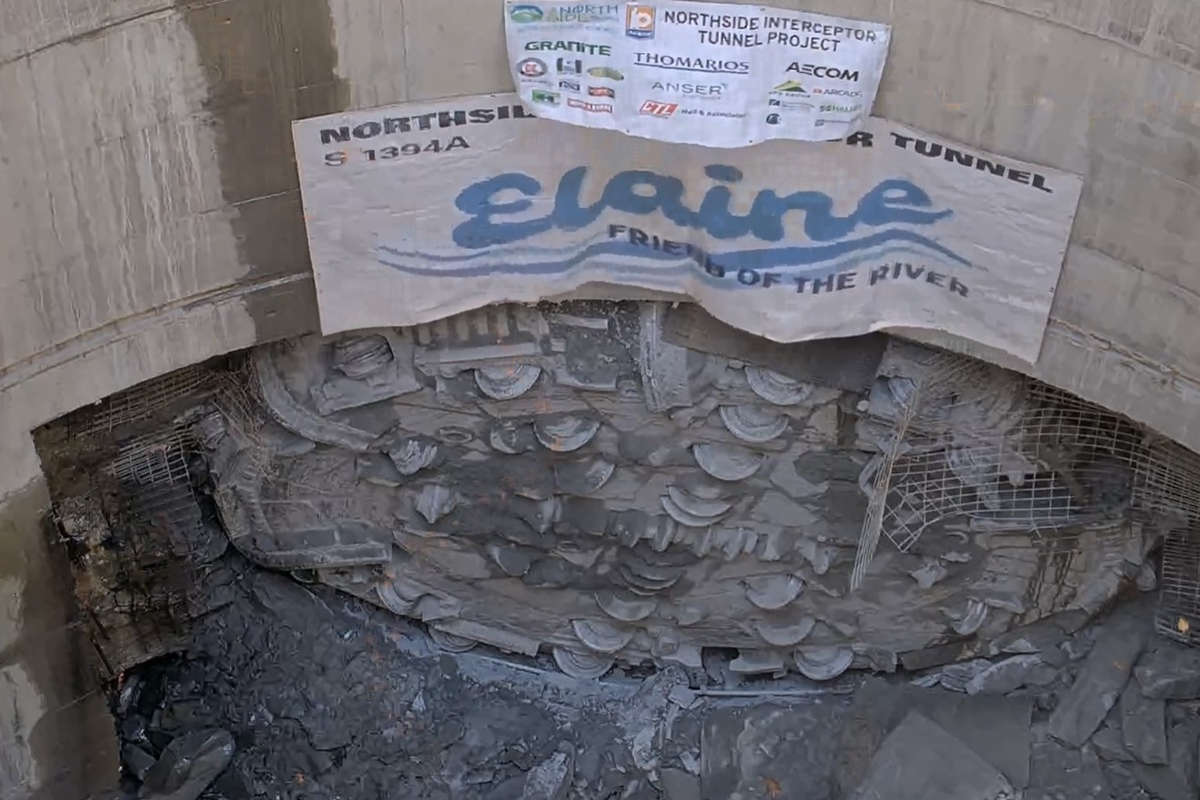
Excavation design is critical particularly where large caverns are needed for containment and module installation. Potential construction approaches include tunnel boring machines for access drifts, drill‑and‑blast, and sequential excavation methods where ground conditions permit for cavern construction. Sequencing is essential because each excavation stage changes the local stress field, influences deformation, and affects the performance of temporary supports.
Monitoring-based observational design reduces underground construction risk such as the use of convergence points, extensometers, piezometers, and micro-seismic systems to track ground and groundwater behavior in real time. Trigger-action levels guide decisions to add support, adjust excavation sequencing, or update design assumptions, especially for large caverns where unexpected rock behavior may occur.
6.3 Support systems, linings, and long‑term durability
Design of temporary and permanent support systems such as rock bolts, shotcrete, steel ribs, and the final structural linings are critical for long term design life. For nuclear applications, support and lining components of safety‑class spaces may be subject to elevated NRC quality assurance requirements. Long‑term durability is critical, as underground environments can increase corrosion, concrete degradation, and joint leakage if detailing is inadequate.
6.4 Groundwater control and watertight safety‑class spaces
Groundwater management is one of the defining challenges for underground SMRs. Effective strategies often rely on barrier redundancy: pre‑grouting to reduce inflows, waterproof membranes to block seepage, and sometimes drainage layers or galleries behind linings to collect and control remaining leakage. For partially underground facilities, shallow groundwater tables can create persistent seepage risk and “bathtub effects” that impose uplift forces on the structures.
6.5 Foundations, basemat support, and uplift resistance
Partially underground reactor facilities place special demands on foundation performance. Designs may require thick reinforced basemats, rock tiedown anchors where competent rock is present, and drainage provisions to manage hydrostatic uplift. Uplift resistance is particularly important for partially underground installations because the below‑grade structure can experience sustained groundwater pressure over decades. Differential settlement or deformation must be controlled to preserve safety margins for containment‑related structures.
6.6 Seismic response and ground‑structure interaction
Fully or partially underground SMRs require site‑specific seismic hazard evaluation and soil/rock‑structure interaction analysis for buried containments and tunnels. Fully underground caverns must address seismic wave propagation through rock and potential fault‑related hazards. Partially underground facilities may experience complex interactions with layered soils and weathered rock, making differential movement and soil‑structure interaction key design considerations. Robust seismic assessment is necessary to confirm that underground structures maintain integrity and that critical systems remain functional after design‑basis events.
6.7 Ventilation, emergency egress, and underground safety systems
Underground siting increases requirements for ventilation, and emergency egress planning. Facilities must provide dedicated intake and exhaust shafts that support both normal operations and emergency events. Compartmentation strategies are needed to prevent smoke or heat migration during fires, and multiple independent egress routes would be required. Partially underground SMRs generally simplify these needs relative to deep caverns because access to the surface is more direct, but below‑grade safety spaces still demand robust ventilation and fire protection design.
Conclusions
SMRs offer scalable, nuclear pathway capable of producing meaningful utility‑scale electricity through smaller modular units typically producing 50–300 MWe, with multi-module plants enabling staged expansion. Partially or fully underground placement can enhance security, provide passive shielding, and improve resiliency to external hazards, but it adds underground construction challenges such as excavation stability, groundwater control and watertightness, seismic and rock–structure interaction, ventilation, emergency response, facility operation, and long-term maintenance. Partially underground SMRs reduce deep tunneling complexity while retaining many benefits, yet still face other issues such as uplift pressures, groundwater intrusion, and nuclear-grade quality assurance requirements.
Successful deployment of fully or partially underground SMR requires close coordination and collaboration among nuclear, geotechnical, and tunnel engineers throughout the project lifecycle.
Nasri Munfah is a Principal and an Executive Vice President of Gall Zeidler Consultants.


Comments are closed here.