
Boring Ahead in the GTA: York Region’s West Vaughan Sewage Tunnel Takes Shape
The Greater Toronto Area is experiencing a period of rapid population growth that is stretching the limits of its infrastructure systems. As a result, initiatives are underway throughout the region to improve everything from subways to sewer systems. York Region, situated just north of the City of Toronto, is among those, as it addresses one of its most pressing wastewater infrastructure gaps with an 11.2-kilometer bored gravity sewer running through the heart of Vaughan, Ontario.
The West Vaughan Sewage Servicing Project (WVSSP), valued at approximately $372 million, is using two tunnel boring machines (TBMs) to build capacity that regional planners say will be essential well into mid-century.
Project Background
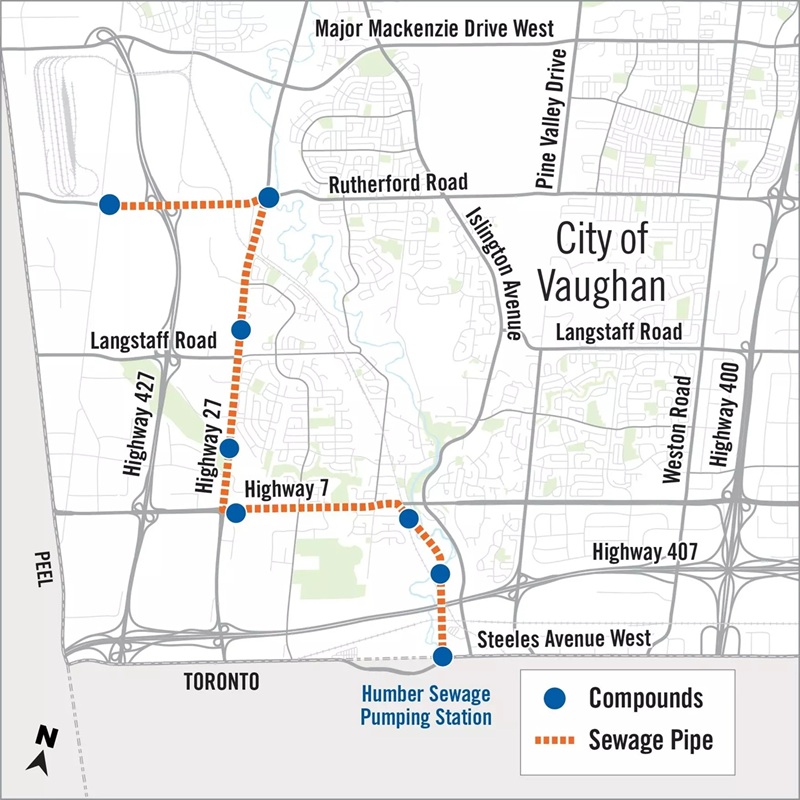
The Regional Municipality of York owns the York Durham Sewage System, which collects wastewater from local sewers and conveys it to the Duffin Creek Water Pollution Control Plant in Pickering for treatment. In the west Vaughan communities — bounded roughly by Rutherford Road, Highway 27, Islington Avenue and Steeles Avenue West — the existing system lacked the trunk capacity to serve expected development, and public project materials frame a deep gravity sewer as the selected long-term servicing solution.
York Region is no stranger to underground construction. Tim Cleary, project manager for prime contractor McNally International, said the region has been commissioning tunneling projects for decades. “They’ve done the Southeast Collector, 16th Avenue, Bathurst, Langstaff, 19th Avenue — and those are just the ones we did,” Cleary said.
The project was delivered under a conventional design-bid-build model, with McNally eventually being selected after being the only one of five pre-qualified five contractors to submit a bid. After a period of negotiation to confirm scope and pricing, the contract was awarded in early May 2024, with notice to proceed issued July 31, 2024. McNally subsequently took on substantial redesign work, revising the segment design and all shaft configurations as part of post-award negotiations and a formal value engineering process.
Project Scope
The new sewer runs from near Rutherford Road and Huntington Road at the north end to the York Region Humber Sewage Pumping Station off Steeles Avenue at the south, traveling primarily along Highways 27 and 7. The tunnel carries a 3.0-meter internal diameter and is segmentally lined with 250-millimeter-thick precast concrete tunnel liner panels manufactured by CSI in Whitby, Ontario.
The alignment is divided into three segments — South, Central and West — and ranges from about 17 meters deep near the pump station to roughly 47 meters at its deepest. Seven shafts are spaced along the route as permanent access and maintenance structures, along with eight surface construction compounds. The primary mining shaft, 5L, at Highways 27 and 7, serves as the launch point for one of the TBMs.
Ground Conditions and Shafts
The geology comprises two distinct zones. About 8.5 kilometers passes through Georgian Bay shale, which McNally project superintendent Jeff Reid described as nearly ideal. “If you could pick material to tunnel through, you’d probably pick this stuff,” he said. “It’s about 20 to 25 megapascals in strength, so it’s strong enough to stand but weak enough to mine.”
The remaining 2.5 kilometers or so consists of mixed soft ground — sands and silts — concentrated around shaft 2L at the north and along the southern drive past shaft 6E toward the pump station. Two railway crossings and the Highway 407 crossing fall in soft ground.
Shaft methods varied. The five shafts in competent shale were built with secant pile walls through the overburden, keyed into the shale, with rock bolts and mesh. The two soft-ground shafts use a sinking caisson method. The caisson at shaft 2L, at 20 meters internal diameter and roughly 23 meters outside, is one of the largest sinking caissons attempted in Ontario, McNally says.
The TBMs
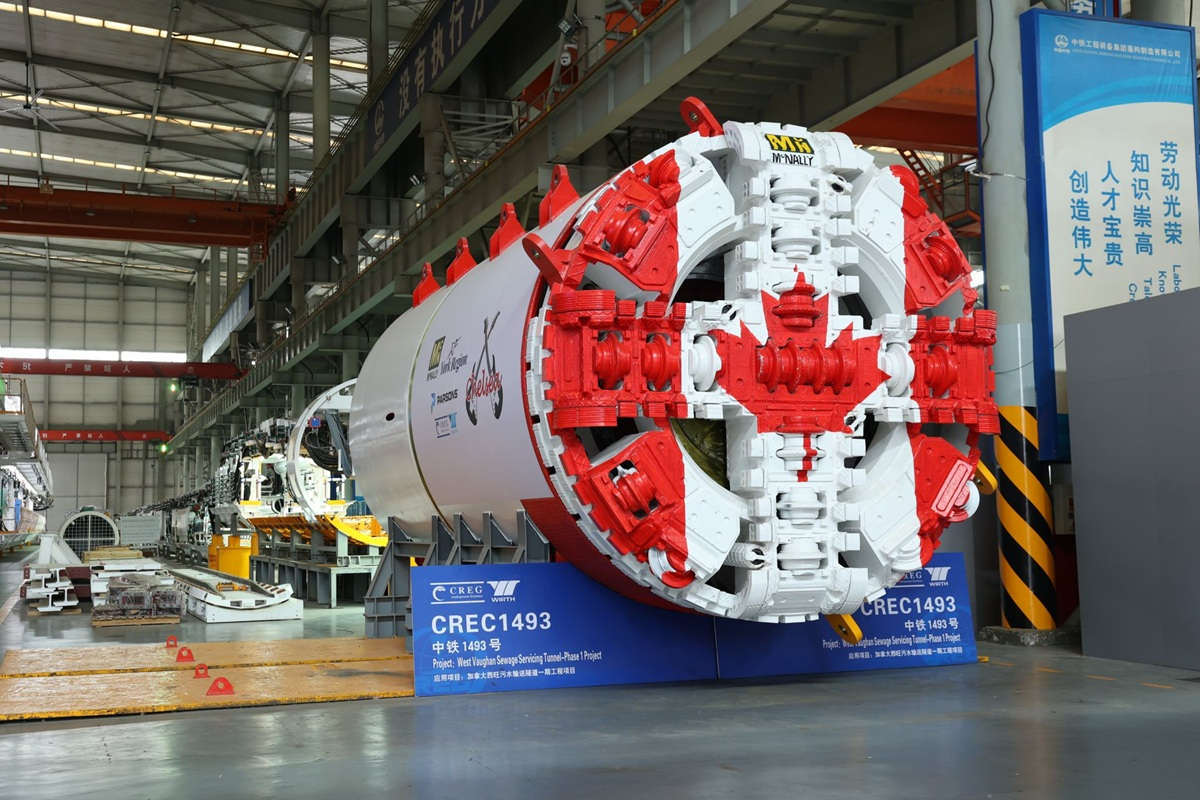
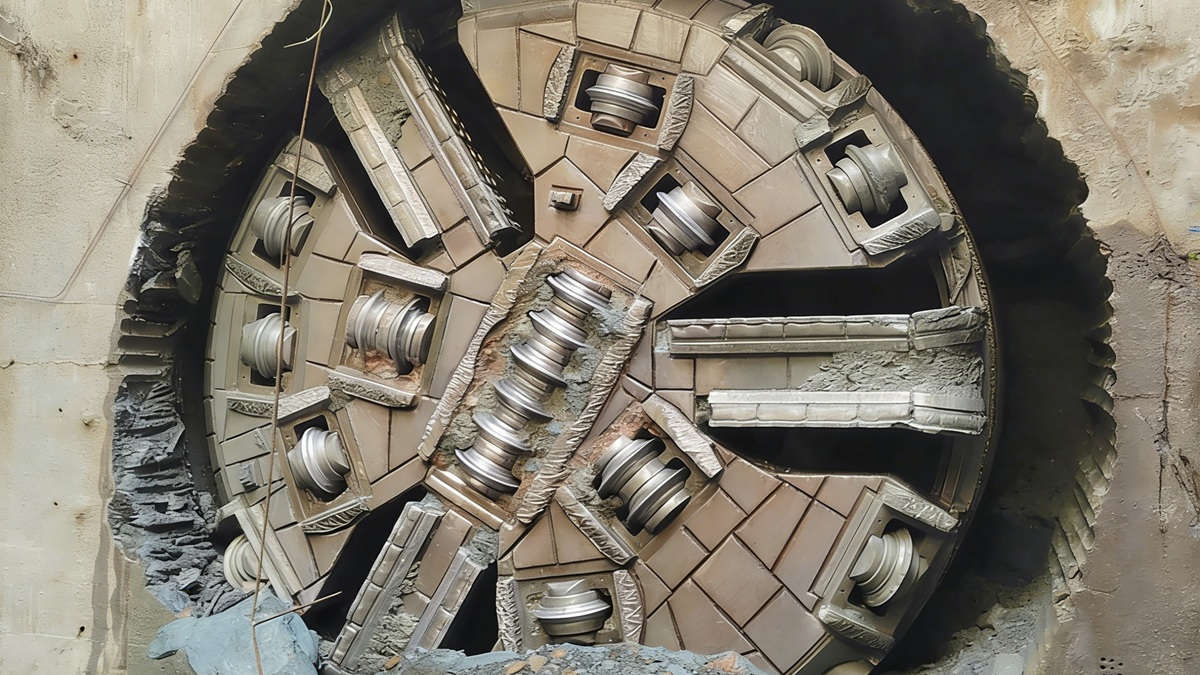
To mine the tunnels, McNally purchased two TBMs from Chinese manufacturer CREG, marking the first use of CREG TBMs in Canada and the United States. Both 3.7-meter diameter machines and earth-pressure balance TBMs with identical configuration. In the shale, they mine in open mode without EPB pressure.
Cleary characterized the machines as straightforward but robustly built. “It’s well built. Even though it is only about a 12-foot machine, it looks like it’s a subway TBM,” he said. It’s built like a tank.”
McNally’s Cleary and Reid traveled to Italy and Germany to visit contractors already running CREG machines, then spent roughly three weeks across multiple visits at CREG’s main facility in Zhengzhou, China, including during factory acceptance testing in April and May 2025. McNally noted that the TBMs incorporate components from internationally sourced brands — Siemens, ABB and Rexroth — meaning that they can be replaced from local inventories if needed. Muck removal is handled by rail and muck cars rather than a continuous conveyor due to space considerations inside the 3.7-meter tunnel.
As of early July 2026, the first TBM had advanced approximately 1.2 kilometers from shaft 5L. Five of seven shafts were fully excavated; secant pile drilling was underway for the sixth, with the seventh planned for completion by fall 2026. Launch of the second TBM was anticipated for December 2026. The scheduled completion date is Oct. 31, 2029.
Looking ahead, Cleary said the project has validated the team’s confidence in the machines and opened a potential avenue for the company’s future work in the region. “We can see how well it’s performing in the shale, and we’re very confident it’ll work very well in the EPB ground,” he said. “This is our home turf. We know what’s coming and what the ground conditions generally are like throughout the greater GTA. I would see us keeping at least one of them, for future projects, if not both.” When complete, the West Vaughan Sewage Servicing Project will provide sustainable wastewater serving and accommodate future growth in the West Vaughan communities through 2051 and beyond.



Comments are closed here.